


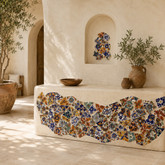
Broken Mexican Talavera Tiles for Backsplashes, Tables, and Garden Projects
Broken Mexican Talavera tiles offer a creative way to bring handcrafted color, cultural character, and artisan texture into both interior and exterior spaces. Their irregular shapes and hand-painted patterns make them especially useful for mosaic work, where perfect repetition is not required and individuality becomes part of the design. Rather than viewing broken tile pieces as leftover material, homeowners and designers can use them to create backsplashes, tabletops, garden accents, planters, fountains, benches, and other decorative surfaces with genuine visual personality.
Because Talavera tiles are made by hand, the fragments naturally display subtle differences in brushwork, color tone, glaze, and thickness. These variations become even more expressive when multiple pieces are combined in a mosaic. The result is a surface that feels artistic, layered, and distinctly Mexican. Whether the project is a compact kitchen accent or a large outdoor installation, broken Talavera tiles provide a flexible decorative material that can adapt to straight surfaces, curves, borders, and irregular architectural forms.
For projects that value color, craftsmanship, and originality, broken Mexican Talavera can transform an ordinary surface into a feature that feels completely custom.
Why Broken Talavera Tiles Are Ideal for Mosaic Projects
Full-size decorative tiles are typically installed in an organized grid. Broken Talavera pieces work differently. Their irregular edges allow the installer to create free-form compositions, geometric mosaics, abstract arrangements, or decorative surfaces that follow the shape of an existing structure.
This flexibility makes broken tile especially useful for surfaces that do not conform easily to a standard tile layout. Rounded planters, curved garden walls, tabletop edges, fountain details, and small architectural niches can all benefit from the adaptable nature of mosaic fragments.
The wide variety of Talavera colors and patterns also gives designers considerable freedom. Pieces featuring cobalt blue, yellow, green, terracotta, white, orange, floral motifs, and geometric designs can be combined to create compositions ranging from relatively restrained to highly colorful.
No two finished mosaics need to look alike, which is one of the material’s greatest strengths.
Creating a Talavera Mosaic Kitchen Backsplash
Kitchen backsplashes are one of the most effective applications for broken Mexican Talavera tiles. The backsplash occupies a visually important position between cabinetry and countertops, making it an ideal area for decorative color and handcrafted detail.
A mosaic made from broken Talavera can cover the entire backsplash or be used selectively behind the range or sink. Concentrating the more elaborate mosaic in one area allows it to function as an artistic centerpiece while surrounding surfaces remain simpler.
Because the pieces are irregular, the final installation feels less formal than a conventional repeating tile pattern. This can add warmth to kitchens with straight cabinetry, polished counters, or contemporary appliances.
Broken Talavera works particularly well alongside natural wood, painted cabinets, stone countertops, copper range hoods, wrought iron, plaster walls, and other materials with visible texture.
Planning Color for a Backsplash
The most successful broken-tile backsplashes usually begin with a color strategy. Although mixing patterns is encouraged, the composition should still feel intentional.
One option is to select fragments that share a dominant color such as cobalt blue. Floral, geometric, and traditional designs can all be combined while the consistent blue creates visual unity.
Another option is a fully multicolored mosaic. In this approach, yellow, blue, green, red, orange, and white fragments are distributed throughout the backsplash. This produces a livelier and more eclectic result that works especially well in rustic, Hacienda, Spanish Revival, or Mexican-inspired kitchens.
Temporarily laying out the pieces before installation helps prevent clusters of similar colors and creates a more balanced surface.
Broken Talavera Tiles for Custom Tabletops
Tabletops are another excellent application because they allow ceramic fragments to function as both decoration and a durable surface. An older table, outdoor base, or custom furniture piece can be transformed with a handmade Talavera mosaic.
Round tables are particularly suited to broken tiles because the irregular pieces can follow the curved perimeter more naturally than standard square tiles. Rectangular and square tabletops also work well and can incorporate borders, center medallions, or free-form compositions.
A tabletop can be designed around a specific palette or assembled from a wide mix of patterns. In either case, the finished piece becomes one-of-a-kind furniture rather than a standardized surface.
For covered patios, breakfast areas, sunrooms, and casual dining spaces, mosaic tabletops can introduce strong visual character without requiring permanent changes to the architecture.
Using Borders and Central Patterns on Tables
Broken Talavera does not have to be installed randomly. Tabletops offer an opportunity to organize fragments into deliberate compositions.
A darker or more consistent color can frame the perimeter while mixed patterns fill the center. Alternatively, the center can feature a geometric or floral arrangement surrounded by a simpler mosaic background.
Another approach is to create concentric rings on a round tabletop. Blue fragments might define the outer edge, multicolored pieces can create the middle section, and a decorative central element can complete the design.
The irregularity of the pieces still remains visible, but thoughtful layout gives the finished table a stronger architectural structure.
Garden Projects with Broken Talavera Tiles
Outdoor environments are especially well suited to the expressive character of Talavera. Sunlight enhances the glossy ceramic surfaces, while vibrant colors contrast beautifully with plants, stone, soil, and natural landscaping.
Broken tiles can be used on garden walls, decorative benches, planters, fountains, pathway accents, outdoor counters, and selected architectural details. Their relatively small size makes them useful for adding color to spaces where full-size tile might feel too formal or repetitive.
In courtyards and gardens inspired by Mexican, Mediterranean, or Spanish architecture, broken Talavera can help connect landscaping with the built environment.
Decorating Garden Planters
Plain planters made from concrete, masonry, or other suitable stable surfaces can be transformed with Talavera mosaic. The irregular fragments are particularly useful for curved containers because they can follow the shape more easily than large tiles.
A fully tiled planter creates a colorful sculptural element, while a narrow mosaic band offers a more restrained treatment. Several planters can also be coordinated using similar palettes while allowing each one to feature a different arrangement.
Green foliage creates a natural contrast with blue, yellow, orange, and white Talavera fragments, making ceramic planters especially attractive in patios and courtyards.
Adding Talavera to Garden Walls and Benches
Garden walls and masonry benches provide larger surfaces for decorative mosaics. Broken tiles can be used across an entire wall section or limited to a framed panel, border, or seating accent.
Built-in garden benches are particularly effective because the tiled surfaces can become part of the architecture. Mosaic fragments can be applied to the vertical face of the bench, the backrest, or other appropriate surfaces while the surrounding masonry remains simpler.
These details create visual continuity between handcrafted ceramics and the surrounding landscape.
Creating Decorative Fountain Features
Water features have a long visual association with colorful ceramic tile. Broken Talavera can be used to add decorative character around selected fountain surfaces, wall panels, or surrounding architectural details, provided the installation system is appropriate for the specific wet environment.
Cobalt blue and white fragments naturally complement water, while green, yellow, and terracotta can connect the fountain visually to nearby plants and stonework.
The irregular mosaic format also works especially well with curved fountain forms, where full-size rectangular tiles may require more cutting.
For installations continuously exposed to water, proper substrates, waterproofing, adhesives, grout, and installation techniques are essential.
Broken Talavera for Outdoor Kitchens
Outdoor kitchens provide another opportunity to combine functionality with handmade decoration. Broken Talavera can be used as a backsplash, on the vertical face of an island, or on selected accent areas around an outdoor serving station.
The colorful ceramic fragments prevent masonry-heavy outdoor kitchens from feeling too utilitarian. They pair naturally with stone, stucco, brick, wood, copper, and iron.
A mosaic panel positioned behind a grill or preparation area can also visually define the cooking zone, turning a functional area into an architectural focal point.
Transforming Garden Pots and Decorative Objects
Smaller mosaic projects are a practical way to experiment with broken Talavera. Decorative pots, trays, wall plaques, and appropriate stable bases can be covered with fragments to create handcrafted accessories.
These projects allow homeowners to work with smaller quantities of material and test different color combinations before beginning a larger installation.
They can also help coordinate a space. For example, fragments similar to those used in a kitchen backsplash can be repeated on a decorative planter or patio table to create visual continuity between indoor and outdoor areas.
Why Handmade Variation Improves the Mosaic
Mexican Talavera tiles naturally vary in color, brushstroke, glaze, surface character, and dimensions because they are handcrafted. Once the tiles become mosaic fragments, these variations add another level of visual richness.
A cobalt section on one fragment may be slightly darker than another. A floral line may be thicker or more expressive. The glaze may reflect light differently from piece to piece.
These characteristics are not mistakes or defects. They are part of the handmade nature of Talavera and help distinguish an artisan mosaic from a surface made with digitally printed industrial tile.
The irregular format of broken pieces makes these differences feel even more natural because the finished design is already based on individuality rather than exact repetition.
How to Arrange Broken Talavera Before Installation
One of the most important steps in a successful mosaic project happens before adhesive is applied. The pieces should be spread out and reviewed as a group so colors, sizes, and patterns can be distributed deliberately.
Larger fragments can establish visual anchors, while smaller pieces fill gaps between them. It is generally useful to avoid placing too many nearly identical fragments together unless the design intentionally requires a concentrated color area.
The layout can also be adjusted to follow curves, corners, and borders before permanent installation begins.
Taking the time to plan this composition reduces unnecessary cutting and helps ensure a balanced final result.
Understanding the Installation Process
Broken Talavera mosaics generally require a stable, clean, and appropriately prepared substrate. The exact preparation depends on whether the project is indoors, outdoors, vertical, horizontal, or exposed to moisture.
Tile adhesive is applied to the prepared surface, and each fragment is positioned individually. Because the pieces are irregular, the spacing between them will naturally vary. This is part of the visual character of the finished mosaic.
After the setting material has cured according to manufacturer requirements, grout is worked into the spaces between the fragments. Excess grout is then removed carefully from the glazed ceramic surfaces.
Outdoor, wet-area, countertop, heat-adjacent, or other specialized applications should be evaluated by an experienced installer who can specify suitable waterproofing, membranes, adhesives, grout, substrates, and sealing methods.
Choosing Grout for a Talavera Mosaic
Grout contributes significantly to the final appearance because broken tile installations generally contain more visible grout than conventional square-tile layouts.
A lighter grout can visually separate the fragments and emphasize individual patterns. A darker grout creates stronger contrast and may make the irregular geometry more noticeable. Neutral tones can help unify a highly colorful composition.
The decision should be made after evaluating a sample arrangement because grout color can substantially change how the same tile fragments are perceived.
Balancing Color with the Rest of the Space
Broken Talavera is visually expressive, so surrounding materials are important. A colorful mosaic often benefits from calmer adjacent surfaces that allow the ceramic detail to become the focal point.
Natural wood, plaster, limestone, simple painted walls, terracotta, concrete, and neutral stone all provide useful backgrounds. Metal elements such as wrought iron, aged brass, or copper can add another layer of warmth without competing heavily with the tile patterns.
This does not mean the surrounding design must be minimal. Rather, it should provide enough visual structure to prevent the mosaic from feeling disconnected from the rest of the space.
Combining Broken Talavera with Full-Size Tiles
Broken tiles can also be used alongside full-size Talavera. This combination is especially useful for projects that need both structure and free-form decoration.
A backsplash might use full tiles across most of the wall with a mosaic insert behind the range. A staircase could combine traditional patterned risers with broken-tile decorative landings. A tabletop might use intact border tiles surrounding a mosaic center.
The contrast between ordered repetition and irregular fragments creates depth while maintaining a strong connection to traditional Talavera design.
Designing with Leftover or Mixed Patterns
One of the strengths of mosaic work is that fragments do not need to come from a single pattern. Mixed designs can be intentionally combined to create a more varied composition.
Floral motifs can sit next to geometric fragments, while blue-and-white pieces can be balanced with warmer yellow and terracotta details. The fragments no longer need to reveal the complete original tile design; instead, each becomes part of a larger new composition.
This allows homeowners to approach Talavera more like an artistic medium than a conventional building material.
Explore Mexican Talavera for Your Next Project
Whether you are planning a colorful kitchen backsplash, a custom mosaic table, or a handcrafted garden feature, broken Mexican Talavera tiles offer considerable creative flexibility. Their rich colors, traditional patterns, and handmade character make them suitable for projects where individuality is an important part of the design.
You can explore Mexican Tile Store for Mexican Talavera products, decorative inspiration, and ceramic options for residential projects.
If you have questions about Talavera products, availability, or a particular design idea, you can contact our team for additional assistance.
Conclusion: A Flexible Material for One-of-a-Kind Design
Broken Mexican Talavera tiles open the door to a style of decorating that values creativity over perfect repetition. Their irregular shapes allow them to adapt to backsplashes, tabletops, planters, garden walls, fountains, outdoor kitchens, and many other decorative surfaces.
More importantly, every fragment retains the handmade character of the original tile. Variations in color, brushstroke, glaze, and pattern bring depth to the completed mosaic and ensure that the finished project has its own personality.
For homeowners and designers who want to introduce authentic Mexican color and artisan craftsmanship into everyday spaces, broken Talavera offers a versatile solution. Whether used indoors or outside, on a small accent or a substantial architectural feature, these ceramic fragments can turn an ordinary surface into a distinctive expression of handmade design.