


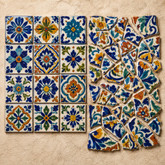
Broken Talavera Tiles vs Full Pattern Tiles: When to Use Each in a Design Project
Choosing between broken Talavera tiles and full pattern tiles is not simply a question of which option looks better. Each creates a different visual rhythm, offers different installation possibilities, and serves a distinct role within an interior or exterior design project. Full pattern Talavera tiles provide repetition, structure, and clearly recognizable motifs, while broken Talavera fragments create organic mosaics defined by movement, irregularity, and creative freedom.
Both approaches preserve the color and handcrafted character associated with Mexican Talavera, but they communicate that character differently. A carefully aligned backsplash made from full pattern tiles can emphasize symmetry and architectural order. A mosaic made from broken pieces can transform the same surface into a more spontaneous artistic composition. Understanding these differences helps homeowners, designers, and builders choose the format that supports the architecture rather than simply adding decoration.
From kitchens and bathrooms to tabletops, staircases, fountains, patios, and garden features, this comparison explains where each option performs best—and why some of the most interesting projects use both.
The Fundamental Difference: Repetition vs Composition
The clearest distinction between full Talavera tiles and broken pieces is how they create a design. A full pattern tile has a defined shape and usually contains either a complete motif or part of a repeating composition. Once installed in rows, the individual tiles establish an organized visual rhythm.
Broken Talavera works differently. A fragment may contain only a section of a flower, border, geometric line, or solid field of color. Instead of repeating the original design, the installer rearranges these fragments to create an entirely new composition.
Full tiles therefore rely primarily on repetition. Broken tiles rely on composition. Neither approach is inherently better; the correct choice depends on the visual effect, surface geometry, and architectural purpose of the project.
When Full Pattern Talavera Tiles Are the Better Choice
Full pattern tiles are ideal when a project benefits from visual organization. Their square or rectangular format establishes clear grout lines and makes it possible to repeat decorative motifs consistently across a surface.
This structure is particularly effective in architecture with strong symmetry. Spanish Colonial kitchens, traditional bathrooms, fireplace surrounds, and formal courtyards often benefit from repeated Talavera patterns because the tile reinforces the geometry of the surrounding architecture.
Full tiles also allow the original artwork to remain recognizable. If a particular floral, geometric, or traditional pattern is important to the design concept, using intact tiles ensures that the motif can be appreciated as intended.
When Broken Talavera Tiles Are the Better Choice
Broken Talavera is most effective when the project calls for individuality, irregularity, or adaptation to an unconventional surface. Because the fragments vary in shape and size, they can be arranged around curves, narrow areas, borders, and other architectural forms where a standard grid may be difficult to maintain.
They are also an excellent choice when the goal is to create something closer to mosaic art than conventional tilework. The original patterns become raw artistic material. Colors, brushstrokes, and fragments of motifs are reorganized into a new surface that cannot be duplicated exactly.
This makes broken Talavera particularly attractive for custom tabletops, garden features, planters, mosaic panels, benches, and artistic backsplashes.
Comparing the Visual Effect
Full pattern tiles tend to produce a more ordered appearance. Even colorful patterns feel controlled because their edges align and their motifs repeat at predictable intervals.
Broken tiles create greater visual movement. Irregular grout lines guide the eye in different directions, while fragments of varying sizes interrupt repetition. The effect can feel more relaxed, artistic, rustic, or eclectic depending on the selected colors.
A designer seeking a formal Spanish-inspired kitchen might prefer complete patterned tiles. A homeowner creating an expressive garden wall might prefer broken fragments. The same Talavera tradition can therefore support dramatically different aesthetics.
Kitchen Backsplashes: Which Option Works Best?
Both formats can work exceptionally well in kitchens, but they produce different results. Full Talavera tiles are often the stronger choice when the backsplash needs to establish a continuous decorative pattern. Their regular dimensions create structure between cabinetry and countertops.
Broken Talavera can be more effective when the backsplash is intended to become a custom artistic feature. A mosaic behind the range, for example, can provide contrast while full tiles or simpler surfaces cover the remaining walls.
The choice should also consider the cabinetry. Highly detailed cabinets may benefit from the visual order of full tiles, while simpler cabinetry can provide an excellent background for a more expressive broken-tile mosaic.
Using Both Formats in the Same Backsplash
A combination can offer the best qualities of both formats. Full pattern tiles can establish the primary field while broken Talavera creates a central mosaic panel behind the range or sink.
Another approach is to use intact tiles as a border around an irregular mosaic. The full tiles provide architectural definition, while the fragments introduce movement within the framed area.
This strategy is particularly effective when homeowners appreciate the creativity of broken tile but still want the installation to feel organized and connected to the kitchen architecture.
Bathrooms and Vanity Areas
Full Talavera tiles work beautifully on vanity backsplashes, decorative walls, and other suitable bathroom surfaces where repeated pattern can establish a strong design theme. They can also coordinate naturally with a hand-painted Talavera sink.
Broken fragments are useful for smaller accents such as mirror surrounds, niches, framed mosaic panels, or selected vanity details. Their irregularity can create an artistic counterpoint to the smooth surfaces of a sink, countertop, or mirror.
In a small powder room, either format can make a substantial impact. Full tiles create a cohesive decorative environment, while broken mosaics produce a more individual, handcrafted statement.
Tabletops: Broken Tiles Offer Greater Creative Freedom
Custom tabletops are one application where broken Talavera has a distinct advantage. Fragments can follow round edges, form radial arrangements, fill narrow spaces, and create free-form compositions without depending on a rigid grid.
A round tabletop can feature irregular fragments arranged around a central medallion. A rectangular table can use mixed pieces surrounded by a structured border. Even small side tables can become functional works of ceramic art.
Full tiles remain useful when the desired tabletop design is geometric or highly ordered. They can create checkerboard layouts, repeating patterns, or clearly defined decorative fields.
Stair Risers: Structure or Eclectic Character?
Full pattern tiles are a classic choice for stair risers because the rectangular architectural format naturally accommodates organized rows of tile. Each riser can feature the same pattern or alternate among several coordinated designs.
Broken Talavera creates a different effect. Mosaic risers feel less formal and can turn the staircase into an evolving composition of color and pattern.
The decision depends largely on the architecture. A formal Spanish Colonial staircase may benefit from intact patterns, while a rustic, artistic, or eclectic staircase may look more natural with irregular mosaics.
Fireplace Surrounds
A fireplace naturally attracts attention, so the tile format should reinforce the desired focal effect. Full pattern tiles can frame the firebox with symmetry and repetition, creating a strong architectural border.
Broken Talavera can make the fireplace feel more like a handcrafted art installation. The fragments can follow curved or irregular architectural forms and create a less predictable surface.
It is also possible to combine both approaches, using full tiles to establish a border and broken pieces within a larger decorative field. Any installation close to significant heat should use appropriate substrates and setting materials for the specific conditions.
Garden and Courtyard Projects
Outdoor environments often favor broken Talavera because gardens already contain organic shapes and natural variation. Irregular fragments feel comfortable alongside plants, stone, masonry, wood, and water.
Planters, benches, garden walls, fountain surrounds, and decorative panels are excellent locations for mosaic compositions. Broken pieces can adapt to curves and unconventional dimensions while introducing vivid color.
Full tiles remain highly effective in courtyards that have more formal architecture. Repeated patterns can define wall panels, outdoor kitchen backsplashes, or architectural borders with greater precision.
Fountains and Curved Architectural Forms
Curves can make full-size tiles more challenging because individual pieces may require cutting to follow the geometry. Smaller broken fragments naturally provide greater flexibility.
This makes mosaics useful on selected curved fountain details and other appropriate rounded structures. Blue, white, green, and multicolored Talavera fragments can interact beautifully with water and surrounding vegetation.
However, wet-area installation requires more than decorative planning. Surfaces exposed continuously to water need suitable waterproofing, adhesives, grout, and substrate preparation determined for the specific application.
Pattern Visibility Is an Important Consideration
If the beauty of a particular Talavera design depends on seeing the complete motif, full tiles are usually the better choice. Cutting or breaking the tile may remove the visual relationship between individual parts of the artwork.
Broken tile works best when the fragments themselves are appreciated for color, line, and partial pattern rather than for preserving the complete original image.
This distinction is important. A detailed pictorial or highly structured pattern may lose much of its intended effect when fragmented, while simpler floral or geometric tiles may create beautiful abstract pieces after breaking.
How Handmade Variation Affects Both Formats
Whether installed whole or used as fragments, handmade Talavera naturally exhibits variations in color, glaze, brushwork, dimensions, and surface character. These differences result from artisan production and kiln firing.
With full tiles, variation appears across repeated patterns, giving the installation depth and preventing it from looking mechanically printed. One blue area may be slightly darker than the corresponding area on the next tile, while brushstrokes may differ subtly.
In broken mosaics, these variations become even more integrated into the composition. Because the fragments are already irregular, tonal differences and partial brushwork contribute naturally to the artistic effect.
In both cases, variation should be understood as part of the uniqueness of handmade Talavera rather than as a defect.
Installation Considerations for Full Pattern Tiles
Full pattern tiles require careful layout because grout lines and motif alignment remain highly visible. Before installation, tiles should be reviewed and mixed so natural color variations are distributed throughout the surface.
Dry laying important sections can also help determine where individual patterns should appear. This is particularly useful for decorative panels, backsplashes, and installations where the relationship between adjacent motifs matters.
Because handmade tiles can have dimensional variations, installers should work with the actual material rather than assuming every piece will behave exactly like an industrially calibrated tile.
Installation Considerations for Broken Talavera
Broken Talavera requires a different type of planning. Instead of aligning rows, the installer must balance fragment size, color, pattern, and spacing.
Larger pieces can establish the main visual structure, while smaller fragments fill gaps. Temporarily arranging pieces before installation makes it easier to distribute colors evenly and avoid unintended clusters.
Grout also becomes more visually important because irregular fragments naturally create varying joints. The grout color should therefore be considered part of the overall design.
Which Format Is Easier to Maintain?
Both formats use glazed ceramic surfaces that can be practical for many decorative applications when properly installed. The main maintenance difference often comes from the grout configuration rather than the Talavera itself.
Full tiles generally produce fewer and more predictable grout lines. Broken mosaics typically contain more grout because numerous small fragments must be separated and joined.
For surfaces where frequent cleaning is expected, this distinction may influence the decision. Appropriate grout selection, installation, and maintenance practices can help support long-term performance.
Choosing Based on the Size of the Project
Scale can help determine which option is most effective. Across a large wall, repeated full patterns may create stronger visual organization. A very complex broken mosaic across the same area can become highly expressive and may require careful balancing with surrounding materials.
Smaller areas such as niches, tabletops, mirror frames, and decorative panels are excellent opportunities for broken tile because concentrated detail can become a focal point.
There is no strict rule, however. Large mosaic walls can be spectacular when intentionally designed, while a single full patterned tile can provide a beautiful small accent.
When to Choose Full Pattern Talavera Tiles
Full tiles are generally the stronger option when the project requires symmetry, recognizable patterns, cleaner grout lines, architectural repetition, or a more traditional installation. They are particularly effective for backsplashes, bathroom walls, stair risers, fireplace surrounds, and structured decorative panels.
They also make sense when a specific hand-painted motif is central to the design and should remain visible in its complete form.
When to Choose Broken Talavera Tiles
Broken Talavera is generally better suited to projects that prioritize artistic freedom, irregular surfaces, curved forms, mixed colors, or one-of-a-kind mosaic composition.
Tabletops, planters, garden walls, benches, mirror frames, mosaic artwork, decorative niches, and custom accent panels provide especially strong opportunities for fragments.
Broken tile also allows designers to reinterpret traditional Mexican ceramic patterns in a more abstract and contemporary way.
When Combining Both Is the Best Solution
A design project does not always require choosing one format exclusively. Combining full pattern tiles with broken Talavera can create a sophisticated relationship between order and spontaneity.
A structured border can frame a free-form mosaic. Full tiles can cover the main backsplash while fragments define a focal panel. Intact stair risers can lead toward a mosaic landing. A tabletop can use complete border tiles around a broken-tile center.
These combinations allow the eye to alternate between recognizable craftsmanship and creative reinterpretation, giving the installation greater visual depth.
Explore Mexican Talavera for Your Design Project
The right choice between broken Talavera and full pattern tiles ultimately depends on the architecture, desired visual rhythm, installation surface, and level of artistic freedom you want to introduce. Both formats can celebrate Mexican ceramic craftsmanship while producing distinctly different results.
You can explore Mexican Tile Store for Talavera products and inspiration for kitchens, bathrooms, furniture, patios, gardens, and decorative architectural projects.
If you have questions about Talavera products, availability, or selecting tile for a particular application, you can contact our team for additional assistance.
Conclusion: Choosing the Right Talavera Format for the Design
Broken Talavera tiles and full pattern tiles express the same Mexican ceramic tradition in two very different ways. Full tiles emphasize pattern, rhythm, and architectural structure. Broken fragments emphasize movement, individuality, and artistic composition.
The strongest choice depends on what the surface needs to accomplish. A traditional backsplash may benefit from complete repeating patterns, while a garden planter or custom tabletop may come alive through irregular fragments. In other projects, combining both formats can create an effective balance between order and creativity.
Rather than asking which type of Talavera is universally better, designers should consider which format best supports the architecture and purpose of the project. Used thoughtfully, both full pattern and broken Mexican Talavera tiles can turn an ordinary surface into a distinctive expression of color, craftsmanship, and handmade character.