


Creative Ways to Use Broken Mexican Talavera Tiles in Home Décor
Broken Mexican Talavera tiles offer a distinctive way to bring color, craftsmanship, and artistic character into home décor. Instead of treating irregular tile fragments as leftover material, designers and homeowners can use them as a creative medium for mosaics, accent surfaces, furniture, garden features, and architectural details. Their uneven shapes, hand-painted patterns, and vibrant colors make them especially well suited to projects where visual texture and individuality are part of the design.
Because Talavera tiles are traditionally handcrafted and hand painted, every fragment carries its own combination of color, brushwork, glaze, and pattern. When these pieces are arranged together, they create surfaces that feel layered and expressive rather than repetitive. Broken Talavera can therefore become an effective solution for both small decorative upgrades and larger custom installations.
From tabletops and stair risers to backsplashes, planters, mirrors, and courtyard walls, broken Mexican Talavera tiles allow ordinary surfaces to become personalized works of ceramic art.
Why Broken Talavera Tiles Work So Well for Decorative Projects
Traditional square tiles depend on repetition and alignment, while broken Talavera pieces create a completely different visual language. Their irregular shapes make each installation unique, allowing patterns to develop organically rather than through a fixed grid.
This freedom is particularly valuable in creative home décor. Small pieces can be rotated, mixed, trimmed, and arranged to follow curves or fill unusual spaces that would be more difficult to cover with full tiles.
Talavera also offers a broad palette of cobalt blue, yellow, green, terracotta, white, orange, and other colors. Combining fragments from different patterns can produce mosaics with exceptional depth and visual energy.
The finished surface retains the recognizable character of Mexican ceramics while gaining a more spontaneous and artistic appearance.
Creating Custom Mosaic Backsplashes
A kitchen or bathroom backsplash is one of the most practical places to use broken Talavera tiles. Instead of installing a repeating pattern, individual fragments can be combined into a custom mosaic that becomes an original focal point.
In kitchens, the mosaic can be concentrated behind the range or sink while surrounding areas use simpler materials. This creates visual impact without making the entire room feel overly busy.
Broken Talavera pieces work particularly well with natural wood cabinetry, painted cabinets, copper accents, wrought iron, stone countertops, and plaster walls. These surrounding materials allow the ceramic colors to stand out while maintaining warmth and balance.
A mixed-pattern backsplash can also incorporate fragments from several Talavera designs. Rather than attempting to match every piece, the variation itself becomes part of the composition.
Transforming Old Tabletops
One of the most creative ways to reuse broken Mexican tiles is to transform an existing tabletop into a handmade mosaic surface. An older table with a worn top can gain a completely new identity through colorful ceramic fragments.
Round, square, and rectangular tables can all work well for this application. Broken pieces make it easier to follow curved edges and create central medallions, geometric compositions, or free-form patterns.
For a more structured appearance, designers can create a border using pieces from similar patterns while using a more varied combination in the center. For an eclectic result, fragments can be arranged randomly according to color and shape.
The finished table becomes both functional furniture and decorative artwork, making this approach especially effective for patios, breakfast areas, covered terraces, and casual dining spaces.
Adding Color to Stair Risers
Stair risers provide an ideal canvas for broken Talavera mosaics because they naturally divide a staircase into repeated decorative sections. Rather than covering every tread, the ceramic pieces can be installed vertically on the risers where they remain visible as people move through the home.
Each riser can feature a different combination of fragments, creating rhythm and movement. Another option is to maintain a consistent color palette throughout the staircase while varying the individual patterns.
In Spanish Colonial, Hacienda, Mediterranean, and eclectic interiors, mosaic stair risers can become one of the most memorable architectural features in the home.
They also offer a practical way to introduce strong color into transitional areas such as entry halls and staircases without changing the entire surrounding palette.
Designing Decorative Mirror Frames
A basic mirror can be transformed into a handcrafted decorative feature by surrounding it with broken Talavera fragments. This approach works particularly well in powder rooms, bathrooms, hallways, and entryways.
The irregular tile edges naturally create visual movement around the mirror. Blue-and-white fragments can produce a more restrained composition, while multicolored pieces create a lively Mexican-inspired accent.
Because mirrors often sit above sinks or vanities, a Talavera mosaic frame can also coordinate with ceramic bathroom fixtures or other tile details in the room.
This type of project is particularly useful when the goal is to introduce Talavera on a smaller scale rather than covering an entire wall.
Decorating Planters and Garden Containers
Broken Talavera tiles are exceptionally well suited to decorative planters. Ceramic fragments can be applied to plain terracotta, concrete, or masonry containers to create colorful surfaces that complement plants and flowers.
The combination of greenery and hand-painted ceramic produces a naturally vibrant effect. Blues and whites contrast beautifully with foliage, while yellow, orange, and terracotta fragments can reinforce the warmth of outdoor environments.
Planters can feature completely random mosaics or more controlled patterns based on bands, borders, or repeated colors.
For patios and courtyards, several coordinated mosaic planters can help establish a cohesive decorative theme without requiring extensive architectural changes.
Creating Courtyard and Patio Accent Walls
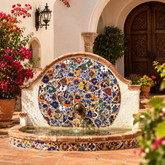
Broken Talavera can also be used on larger architectural surfaces. A courtyard wall, outdoor kitchen backsplash, built-in bench, or garden feature can become a custom mosaic installation that integrates Mexican ceramic artistry directly into the architecture.
Outdoor spaces often provide more freedom for bold patterns and color combinations. Sunlight enhances the glossy glaze of Talavera, allowing individual fragments to reflect light differently throughout the day.
A mosaic accent wall can work especially well behind a fountain, seating area, or outdoor dining space. The irregular surface introduces texture while the colors help connect the architecture with plants, terracotta, stone, and other natural materials.
Enhancing Fireplace Surrounds
Fireplaces naturally function as focal points, making them ideal locations for decorative Talavera mosaics. Broken tiles can be arranged around the firebox, across the mantel face, or on surrounding architectural panels.
Because the fragments do not need to follow a rigid grid, they can adapt to arches, curves, and irregular fireplace shapes more easily than conventional full tiles.
A multicolored mosaic works well in rustic and eclectic interiors, while a more controlled blue-and-white composition can create a refined Spanish or Mediterranean look.
As with any fireplace installation, materials and adhesives should be selected according to the heat conditions of the specific installation.
Using Broken Talavera for Decorative Niches
Built-in niches are excellent locations for ceramic accents because their recessed form naturally frames the tilework. Broken Talavera can be used on the back surface of a niche to create a concentrated area of color and pattern.
This technique works in bathrooms, hallways, kitchens, stair landings, and architectural alcoves. Even a small niche can become a strong decorative detail when lined with vibrant ceramic fragments.
Because the installation area is relatively limited, niches are also useful for homeowners who want to experiment with mixed Talavera patterns without committing to a large mosaic.
Creating Unique Bathroom Accents
Bathrooms offer numerous opportunities for broken Talavera applications beyond backsplashes. Mosaic fragments can be used around mirrors, behind vanities, on decorative borders, around built-in shelves, or on selected wall areas.
Pairing a Talavera mosaic with a handmade ceramic sink can create a particularly cohesive design. The sink provides a central artistic fixture while the broken tile fragments extend the ceramic theme into the surrounding architecture.
Neutral stone, plaster, wood, or simple painted surfaces can help balance the colorful ceramic details and prevent the room from feeling visually crowded.
Turning Furniture into Decorative Statements
Broken Talavera does not need to remain limited to walls and architectural surfaces. Furniture can also become a canvas for mosaic decoration.
Console tables, side tables, benches, outdoor bars, and serving stations can all incorporate ceramic fragments. A plain furniture piece can gain substantial visual character with only a relatively small tiled section.
For example, the top of a wooden console can be finished with Talavera mosaic while the base remains simple. This creates contrast between the handmade ceramic surface and the natural texture of the furniture.
Furniture applications are especially useful for introducing Talavera into homes where permanent architectural modifications are not desired.
Designing Decorative Borders and Architectural Bands
Broken tile pieces can also be used more selectively as decorative borders. Instead of covering an entire wall, a narrow mosaic band can run horizontally across a backsplash, bathroom wall, patio surface, or staircase.
This approach provides color and craftsmanship while keeping the overall composition restrained. It is particularly effective in rooms where another material—such as stone, plaster, or painted drywall—remains dominant.
The irregularity of the broken pieces creates a more handmade appearance than a conventional straight tile border.
Creating Mosaic Art Panels
For homeowners who want Talavera primarily as artwork, broken pieces can be arranged into framed mosaic panels. These compositions can feature abstract patterns, floral designs, geometric motifs, or imagery inspired by Mexican decorative traditions.
The finished panel can then be installed on a wall much like a painting or architectural artwork. This allows the ceramic pieces to become portable decorative objects rather than permanent wall coverings.
Mosaic panels are also useful for incorporating leftover fragments from another installation, turning smaller quantities of tile into meaningful decorative features.
Why Mixed Patterns Can Look Better Than Perfect Matching
One of the advantages of working with broken Talavera is that perfect matching is unnecessary. In fact, a successful mosaic often depends on variety.
Fragments from different patterns can be combined according to color families, visual density, or motif. A predominantly blue mosaic might contain floral, geometric, and traditional patterns while still appearing cohesive because the palette connects the pieces.
Alternatively, a highly colorful composition can intentionally mix many designs to achieve a more expressive effect.
The key is visual balance rather than repetition. Larger fragments can be distributed throughout the design while smaller pieces fill the spaces between them.
Planning the Layout Before Installation
Because broken tiles are irregular, planning is especially important. Before applying adhesive, pieces should be arranged temporarily so the installer can evaluate color distribution, spacing, and overall composition.
It is usually helpful to avoid placing too many fragments of the same pattern or color next to one another unless that effect is intentional. Mixing the pieces first gives the finished surface a more balanced appearance.
For complex mosaics, working in small sections can make installation easier and help maintain the desired arrangement.
The Basic Installation Process
The installation process depends on the surface and application, but broken Talavera mosaics generally require a clean, stable substrate, appropriate tile adhesive, grout, and suitable tools.
The fragments are pressed individually into the adhesive while maintaining reasonable spacing between pieces. Because the shapes are irregular, grout lines will naturally vary.
Once the adhesive has cured, grout is applied across the installation to fill the spaces between fragments. The surface is then cleaned carefully to reveal the glazed ceramic designs.
For specialized installations, wet environments, outdoor applications, or surfaces exposed to heat, an experienced tile installer should determine the appropriate substrate, setting materials, waterproofing, and sealing requirements.
Handmade Variation Makes Every Mosaic More Interesting
Talavera tiles already display natural variation before they are broken into mosaic pieces. Differences in glaze, brushwork, color intensity, and dimensions result from their handmade production process.
Once fragments from multiple tiles are combined, these variations become even more expressive. The mosaic contains not only different patterns but also subtle tonal differences that create depth and movement.
These characteristics should not be treated as defects. They are part of the artisan nature of Mexican Talavera and contribute directly to the individuality of the completed project.
Explore Mexican Talavera for Creative Home Projects
Broken Talavera mosaics provide an opportunity to approach interior decoration with greater creativity and individuality. Whether you are planning a backsplash, tabletop, staircase, planter, courtyard, or custom decorative feature, the combination of hand-painted ceramic fragments can produce a result unlike any standardized tile installation.
You can explore Mexican Tile Store for Talavera products and inspiration for residential and decorative projects.
If you have questions about Mexican Talavera, product availability, or a specific project, you can also contact our team for additional assistance.
Conclusion: Turning Broken Tiles into Original Design
Broken Mexican Talavera tiles demonstrate that irregularity can become a powerful design advantage. Their fragmented shapes, colorful patterns, handcrafted variation, and cultural character allow homeowners to create surfaces that feel spontaneous, artistic, and highly personal.
From kitchen backsplashes and bathroom accents to tabletops, mirrors, stair risers, planters, fireplaces, and courtyard walls, broken Talavera can transform everyday elements into custom decorative features. The material encourages creativity rather than rigid repetition, making every finished mosaic genuinely unique.
For interiors that value craftsmanship, color, and originality, broken Mexican Talavera tiles offer an inspiring way to bring handmade ceramic artistry into the home while creating a design that cannot be duplicated exactly anywhere else.