


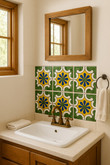
How Pattern Tiles Can Transform a Small Powder Room
A small powder room may have limited square footage, but that does not mean it needs to have limited personality. In fact, compact bathrooms are some of the best spaces for decorative pattern tiles because a relatively small amount of ceramic can completely change how the room feels. Colorful Mexican pattern tiles can transform a plain vanity wall, backsplash, niche, or selected feature wall into a focal point filled with color, craftsmanship, and architectural character.
Because powder rooms typically contain fewer functional elements than full bathrooms, each design decision becomes more noticeable. The relationship between the sink, vanity, mirror, lighting, wall finish, and tile can define the entire room. Hand-painted Mexican tiles are particularly effective because they introduce more than pattern alone. Subtle differences in brushwork, glaze, color, and surface character give the installation a handmade quality that contrasts beautifully with smooth countertops, mirrors, and fixtures.
The key is not necessarily using more tile. It is deciding where pattern will have the greatest visual impact and allowing the rest of the room to support it.
Why Small Powder Rooms Are Ideal for Pattern Tiles
A powder room is usually one of the smallest rooms in a home, but its compact dimensions can actually become a design advantage. A decorative surface that might feel secondary in a large bathroom can become immediately noticeable in a smaller space.
A few square feet of patterned tile behind a vanity may be enough to establish the room's complete color palette. A feature wall can become the first thing guests notice when opening the door. Even a narrow border can provide definition and visual movement.
This concentrated impact makes pattern tile an efficient way to give a powder room a distinctive identity without redesigning every surface.
Small Does Not Have to Mean Visually Quiet
One common approach to small rooms is to make everything neutral in an attempt to make the space appear larger. While restrained palettes can certainly work, they are not the only solution.
Strong pattern can give a small powder room depth and personality. Instead of trying to disguise the compact dimensions, the design can celebrate them by creating an immersive or highly focused decorative experience.
The important consideration is hierarchy. If patterned tile is the strongest element, other surfaces can remain calmer so the room feels intentional rather than crowded.
Turn the Vanity Wall into the Main Feature
The vanity wall is usually the most natural location for pattern tile because it is already a visual destination. The sink, faucet, countertop, and mirror direct attention toward this area, so adding decorative tile strengthens an existing focal point.
Pattern tiles can cover the area between the countertop and mirror, extend around the mirror, or continue from the vanity to the ceiling for a more dramatic effect.
In a very small powder room, treating only the vanity wall may provide enough visual interest for the entire space.
Create a Compact Pattern Tile Backsplash
A backsplash is an excellent option when homeowners want color without committing to a full tiled wall. Even a relatively narrow section behind the sink can introduce substantial decorative character.
A repeating floral or geometric design creates structure, while mixed patterns can produce a more eclectic effect. Blue-and-white tiles offer a restrained interpretation, whereas multicolored Mexican tiles can make the backsplash the most expressive feature in the room.
The compact scale also allows homeowners to use decorative tile selectively while leaving painted or plastered walls visible around it.
Use a Full Feature Wall for Maximum Impact
For a more dramatic powder room, pattern tiles can cover an entire selected wall. The vanity wall is the obvious choice, but another wall visible from the doorway can also become an architectural feature.
A full wall gives repeating patterns enough space to establish rhythm. It can also make the bathroom feel more deliberately designed because the tile becomes part of the architecture rather than a small accessory.
When using a highly detailed feature wall, simplifying adjacent surfaces helps maintain balance.
Blue-and-White Pattern Tiles for a Refined Look
Blue-and-white Mexican pattern tiles are particularly effective in compact bathrooms because they introduce decoration while maintaining a relatively controlled palette.
Cobalt blue provides strong visual definition, while white areas keep the pattern bright and open. The combination works well with white or cream walls, natural wood, stone, and warm metal fixtures.
Blue and white can support Spanish Colonial and Mexican-inspired interiors, but the palette also adapts easily to Mediterranean, transitional, eclectic, and even contemporary powder rooms.
Multicolored Tiles for a More Expressive Powder Room
A powder room is one of the best places to experiment with a stronger palette. Mexican pattern tiles incorporating cobalt, yellow, green, terracotta, red, turquoise, and white can turn a small space into a colorful design statement.
Because the room is compact, the tile does not need to cover every surface. A multicolored backsplash or feature wall may provide all the color required.
Surrounding materials can then repeat selected tones from the ceramic, creating cohesion without reproducing every color throughout the room.
Choose One Pattern for Greater Visual Order
Repeating a single pattern is one of the easiest ways to introduce decorative tile without making a small bathroom feel overly complex.
The repeated motif establishes rhythm, and the regular layout provides visual organization. This structure can support surprisingly detailed artwork because the eye quickly understands the repetition.
Handmade variation keeps the installation from becoming mechanically uniform. Even when the same design is repeated, slight differences in brushwork, glaze, and color give each tile individual character.
Mix Patterns for an Eclectic Effect
For a more artistic powder room, several Mexican tile patterns can be mixed together. Floral, geometric, and traditional motifs can create a patchwork composition with substantial personality.
The most successful mixed installations usually share something in common. A recurring cobalt blue, consistent background color, similar pattern scale, or repeated group of colors can hold the composition together.
Before installation, laying out the tiles on a flat surface helps distribute similar designs and colors intentionally.
Use Pattern Tile to Frame the Mirror
A mirror surround is another effective way to use pattern tile in a small powder room. Rather than tiling the entire wall, decorative ceramic can form a frame around a simple mirror.
This concentrates attention around the vanity and creates a custom architectural detail from a relatively small amount of material.
A narrow patterned border can feel refined, while a wider frame produces a stronger statement. The mirror itself provides visual relief in the center of the composition, helping balance a detailed pattern.
Combine Pattern Tiles with a Talavera Sink
A hand-painted Talavera sink and patterned tile can create a particularly distinctive powder room, but the two elements should be coordinated thoughtfully.
The sink and backsplash do not need to feature identical artwork. Often, a more sophisticated result comes from sharing only selected colors.
For example, a Talavera sink with cobalt, green, and yellow details might be paired with tiles that emphasize cobalt and white. The shared blue creates continuity while the different patterns preserve individuality.
Let the Sink Be the Focal Point
In some powder rooms, the sink should carry most of the decoration. A colorful Talavera basin can be surrounded by simpler pattern tiles or a restrained backsplash that supports rather than competes with it.
This creates a clear hierarchy: the eye notices the sink first and then discovers the surrounding ceramic details.
When several handmade elements are used together, deciding which one should dominate is often more important than trying to make every piece equally decorative.
Pattern Tiles and Natural Wood Vanities
Natural wood is an excellent companion for colorful tile because it provides warmth without introducing another competing pattern.
Dark wood can make cobalt, white, yellow, and green tiles appear especially vivid. Medium wood tones produce a relaxed traditional atmosphere, while lighter woods can make Mexican patterns feel more contemporary.
The natural grain also complements the artisan variation of handmade ceramic. Together, the materials create a bathroom that feels layered and tactile rather than industrially uniform.
Pair Pattern Tile with a Simple Stone Countertop
Countertops and backsplashes meet directly, so their visual relationship deserves careful consideration. If the pattern tile is highly detailed, a relatively quiet countertop can provide necessary balance.
Stone with subtle movement can add natural character without challenging the tile for attention. A simple countertop can also create a visual transition between a wood vanity and a colorful ceramic wall.
Rather than trying to match the tile exactly, look for a countertop whose overall tone complements the ceramic palette.
Warm Metal Fixtures Add Another Layer
Faucets, mirror frames, lighting, and cabinet hardware can help connect pattern tiles to the rest of the powder room.
Warm metal finishes such as brass and bronze-inspired tones often work naturally with Mexican ceramics. They can reinforce yellow and terracotta accents while providing contrast with cobalt blue and green.
Wrought iron can create a stronger Spanish Colonial or Hacienda character. In a contemporary interpretation, simpler fixture shapes can balance the traditional craftsmanship of the tile.
Use the Tile to Establish the Entire Color Palette
Choosing the pattern tile early can simplify many later design decisions. Instead of selecting wall paint, hardware, textiles, and accessories independently, the ceramic can become the reference palette.
Select one dominant tile color for the primary relationship and one or two secondary colors for smaller details. A blue accent might influence the vanity color, while a warm yellow or terracotta tone connects with metal fixtures.
This creates cohesion without requiring literal matching.
Pattern Can Add Visual Depth
A patterned surface naturally encourages the eye to examine details. In a compact powder room, this can create a stronger perception of depth than a completely plain wall.
Geometric patterns establish movement across the surface, while floral motifs provide organic complexity. Glazed ceramic also interacts with light, creating reflections that change depending on viewing angle.
The result is a wall that feels visually layered rather than flat.
Consider What Guests See from the Doorway
Because powder rooms are small, the view from the entrance is particularly important. Before deciding where to install pattern tile, stand outside the room and identify which surface is immediately visible.
If the vanity faces the doorway, a patterned backsplash may be enough. If a side wall dominates the view, a decorative panel or feature wall there might have greater impact.
Designing around the primary sightline ensures that the most decorative material is placed where it will actually be appreciated.
Use Pattern Tiles to Highlight an Architectural Niche
If the powder room contains a recessed niche, pattern tile can turn it into an intentional decorative feature. The surrounding wall can remain simple while the interior of the niche introduces color and pattern.
This strategy creates depth because the ceramic appears within an already recessed architectural element.
A niche can also provide an opportunity to use a stronger pattern than might be appropriate across an entire wall.
Create a Decorative Border
A narrow border of Mexican pattern tiles can transform an otherwise simple powder room. Borders can run behind the vanity, frame a mirror, define a wall panel, or create a transition between different wall materials.
This approach is particularly useful when homeowners want handcrafted ceramic character without extensive tile coverage.
The border can repeat one pattern for greater order or combine several designs for a more eclectic appearance.
Combine Pattern Tiles with Plaster Walls
Textured plaster and handmade Mexican ceramic create a natural material relationship. The quiet, matte character of plaster contrasts with the glossy color of glazed tile.
This contrast allows a relatively small tile installation to stand out clearly. It is particularly effective in Hacienda, Spanish Colonial, Mediterranean, and rustic interiors.
Warm off-white or earth-toned walls can also prevent a colorful backsplash from feeling disconnected from the architecture.
Pattern Tiles Can Work in Contemporary Powder Rooms
Mexican pattern tiles are not restricted to historically inspired interiors. They can create compelling contrast in modern spaces as well.
A floating vanity, simple mirror, clean fixtures, and restrained walls can provide a highly controlled setting for a hand-painted tile backsplash. The traditional ceramic becomes an artistic counterpoint to contemporary geometry.
Using a limited color palette can make this combination particularly successful, although multicolored tile can also work when the backsplash is intended to be the dominant feature.
Why Handmade Variation Matters
Handmade Mexican tiles naturally exhibit slight differences in brushwork, color intensity, glaze, pattern placement, dimensions, and surface character.
These variations are part of artisan production rather than flaws that need to be hidden. In fact, they can make a small powder room more visually interesting because the tile is viewed at close range.
Individual brushstrokes and subtle tonal changes become part of the experience of the room.
The Craftsmanship Behind Mexican Pattern Tiles
The distinctive character of handmade pattern tile begins with clay. The material is prepared and formed into individual pieces before being dried and initially fired.
Artisans then decorate the ceramic by hand, creating floral, geometric, and traditional motifs using brushes and pigments. This manual process naturally produces small differences between individual pieces.
The tiles are glazed and fired again, allowing the finished colors and characteristic ceramic surface to develop. Variations produced through painting and kiln firing help explain why a handmade backsplash feels different from a mechanically printed surface.
Plan the Layout Before Installation
Layout is particularly important in a small room because pattern interruptions are easy to notice. Before permanent installation, review how the tiles will relate to the sink, faucet, mirror, outlets, corners, and countertop.
For mixed patterns, dry laying the tiles makes it possible to distribute colors and motifs more evenly. For repeating designs, it helps confirm how patterns connect across the wall.
Planning can also reduce awkward pattern cuts around highly visible architectural elements.
Account for Handmade Dimensions
Artisan-made tiles should not necessarily be expected to have the exact dimensional uniformity of industrially calibrated ceramic.
An installer familiar with handmade tile can accommodate subtle variations through thoughtful layout and grout spacing. These small differences contribute to the finished handcrafted character rather than detracting from it.
The actual material should therefore guide the installation.
Grout Color Can Change the Entire Look
In a small powder room, grout is highly visible because viewers are often standing close to the tile. Its color can significantly influence the finished design.
A lighter grout can create separation between patterns and keep the installation bright. A darker grout emphasizes the grid and can make individual tiles more defined. A restrained neutral grout allows highly colorful designs to remain dominant.
Grout should be selected for both its visual effect and suitability for the specific installation.
Avoid Making Every Surface a Focal Point
The greatest risk when designing a small powder room is not necessarily using too much color; it is creating too many competing focal points.
If the backsplash is highly patterned, the countertop can be simpler. If the Talavera sink is extremely decorative, the surrounding tiles can use a more restrained palette. If the mirror frame is elaborate, lighting can remain comparatively quiet.
This hierarchy allows individual handcrafted elements to feel more important.
Cleaning Pattern Tiles in a Powder Room
Routine care for glazed decorative tile can remain straightforward. Mild soap, warm water, and a soft cloth or nonabrasive sponge are generally appropriate starting points for everyday cleaning.
Abrasive tools and unnecessarily harsh chemicals should be avoided on decorative glazed surfaces. Grout maintenance should follow the requirements of the specific grout product used during installation.
Consistent gentle cleaning helps preserve the clarity and gloss that make hand-painted patterns visually distinctive.
Why a Small Powder Room Can Be Memorable
A powder room does not need expensive materials on every surface to feel special. Because the room is compact, a single handcrafted feature can influence the entire experience.
Pattern tiles provide color, artwork, texture, and cultural character simultaneously. They can make a simple vanity feel custom, give a plain wall architectural importance, or turn a basic mirror into the center of a decorative composition.
This concentration of design is one reason powder rooms offer such an effective setting for Mexican ceramic craftsmanship.
Explore Mexican Pattern Tiles for Your Powder Room
If you are designing a small bathroom or powder room, you can explore Mexican Tile Store for colorful Mexican tiles, handmade patterns, Talavera sinks, and decorative ceramic products that can bring artisan character to the space.
Consider the room's primary sightline, vanity materials, tile coverage, pattern scale, color palette, and surrounding finishes before selecting the final design. A small amount of carefully positioned pattern can often create greater impact than covering every available surface.
If you have questions about Mexican pattern tiles, product availability, or choosing ceramic pieces for a powder room project, you can contact our team for additional assistance.
Conclusion: Small Space, Strong Design
Pattern tiles can transform a small powder room because they concentrate color, craftsmanship, and visual movement into one of the most intimate spaces in the home. A patterned backsplash can redefine a simple vanity, a tiled mirror surround can create an architectural frame, and a feature wall can establish the personality of the entire room.
The most successful designs are not necessarily those with the most pattern. They are the ones that establish a clear focal point and balance it with quieter materials. Natural wood, stone, plaster, warm metals, simple mirrors, and carefully chosen lighting can all provide the visual support that handmade ceramic needs.
Mexican pattern tiles add another dimension through their artisan character. Variations in brushwork, glaze, color, and surface give the finished installation individuality that perfectly uniform materials cannot replicate. In a small powder room, where every detail is visible, that handmade character can turn a functional space into one of the most memorable rooms in the home.