


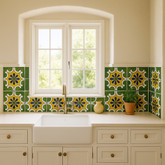
Mexican Pattern Tiles for Creating Colorful Kitchen Backsplashes
Mexican pattern tiles can transform a kitchen backsplash from a practical wall covering into one of the most expressive architectural features in the room. Hand-painted patterns, vibrant colors, and artisan-made surfaces introduce visual warmth that works particularly well with natural wood, stone, plaster, iron, and warm metal finishes. Whether the kitchen is inspired by Spanish Colonial architecture, a traditional Hacienda, Mediterranean interiors, rustic design, or a more contemporary aesthetic, Mexican tiles can provide color without requiring the entire room to become heavily decorated.
The backsplash is an especially effective location for patterned tile because it occupies a highly visible area between countertops and upper cabinetry while remaining relatively contained. Designers can create a complete field of repeating patterns, mix several complementary designs, introduce decorative borders, or reserve the strongest tilework for the area behind the range. The result can range from carefully ordered and traditional to colorful and eclectic.
Understanding pattern scale, color balance, layout, grout, surrounding materials, and handmade variation makes it easier to create a backsplash that feels intentional rather than simply busy.
Why Mexican Pattern Tiles Work So Well in Kitchens
Kitchens naturally contain many functional surfaces. Cabinet doors, countertops, appliances, sinks, and hardware are often dominated by straight lines and practical materials. Patterned ceramic tile introduces an opportunity to soften this structure with color and handcrafted detail.
A backsplash is also positioned close to eye level, making even a relatively small installation visually significant. A colorful tile pattern behind a range or between cabinets may influence the character of the kitchen more strongly than a much larger but less visible surface.
Mexican pattern tiles are particularly effective because their decorative qualities are not limited to color. Brushwork, glaze, pattern, and subtle artisan variation give the wall additional visual depth.
The Backsplash as a Decorative Focal Point
A backsplash can play different roles depending on the overall kitchen design. In some interiors, it acts as a quiet background. In others, it becomes the central decorative feature.
Mexican pattern tiles are ideal for the second approach. A relatively simple kitchen with wood cabinetry and a restrained countertop can support a highly decorative backsplash without feeling excessive.
The tile effectively becomes artwork integrated into the architecture. Unlike a framed picture or temporary accessory, it establishes color and pattern directly within the working surfaces of the kitchen.
Choosing a Color Palette Before Choosing Patterns
One of the most effective ways to create a cohesive Mexican tile backsplash is to begin with color rather than individual patterns.
Traditional Mexican ceramics can incorporate cobalt blue, turquoise, green, yellow, terracotta, orange, red, white, and other tones. Using all of them is possible, but it is not always necessary.
A controlled palette of two or three primary colors can produce a more restrained backsplash. A broader combination creates a more expressive and eclectic installation.
Look at permanent kitchen elements first. Cabinet color, countertop material, flooring, appliances, and major metal finishes can help determine which tile colors will integrate naturally with the room.
Classic Blue-and-White Pattern Tiles
Blue and white is one of the easiest Mexican tile combinations to integrate into a wide range of kitchens. Cobalt patterns create strong definition while the white background keeps the composition visually open.
This palette works especially well with natural wood, white cabinetry, warm plaster, stone countertops, and brass or bronze-inspired hardware.
Blue-and-white tiles can also bridge several design traditions. They feel appropriate in Mexican and Spanish-influenced interiors while adapting easily to Mediterranean, coastal, transitional, and eclectic kitchens.
Using Multicolored Mexican Pattern Tiles
For a more expressive backsplash, multicolored tiles can introduce significant personality. Blues, greens, yellows, terracotta tones, and reds can be combined into a surface that feels energetic and handcrafted.
The challenge is maintaining visual organization. One effective strategy is to repeat a limited group of tile patterns throughout the backsplash rather than introducing a completely different design in every position.
Another approach is to use many patterns but maintain a consistent color palette. The motifs can change while recurring colors hold the composition together.
Repeating One Pattern Across the Entire Backsplash
Using a single Mexican pattern throughout the backsplash is one of the most structured design approaches. The repeated motif creates rhythm and allows individual handmade variations to become part of a larger composition.
This strategy works particularly well when the pattern itself is intricate. Repetition gives the eye enough consistency to understand the design even when individual tiles contain substantial detail.
It can also be an effective choice for traditional Spanish Colonial and Hacienda kitchens where architectural order is an important part of the aesthetic.
Mixing Different Mexican Tile Patterns
Mixed-pattern backsplashes create a more informal and artistic appearance. Instead of repeating one motif, designers can alternate floral, geometric, and traditional decorative tiles.
The strongest mixed installations usually have at least one unifying element. That might be a recurring cobalt blue, similar background color, consistent tile size, or repeated border.
Without some visual connection, a mixed backsplash can become chaotic. With careful selection, however, the variety becomes part of its charm.
Creating a Patchwork Backsplash
A patchwork arrangement intentionally places different patterns beside one another. This approach celebrates variety rather than attempting to create one continuous motif.
Patchwork Mexican tile can work beautifully in eclectic, rustic, bohemian, and Hacienda-inspired kitchens. It is particularly effective when cabinetry and countertops remain comparatively simple.
Before installation, arrange the tiles on a flat surface and review the distribution. Avoid placing too many similar colors or patterns together unless that clustering is intentional.
Creating a Decorative Panel Behind the Range
The area behind the range is one of the strongest locations for a Mexican tile focal point. It naturally occupies a central position and is often framed by cabinetry, a range hood, or surrounding field tile.
A decorative panel can use a more complex pattern than the rest of the backsplash. Full-pattern tiles may form a central composition, while simpler tiles create a border or cover adjacent walls.
This creates hierarchy. Instead of every part of the backsplash demanding equal attention, the range wall becomes the visual destination.
Pairing Pattern Tiles with a Copper Range Hood
Mexican pattern tiles and copper can create an especially warm kitchen composition. Copper introduces an earthy metallic surface, while the ceramic backsplash contributes color and hand-painted detail.
Cobalt, green, yellow, white, and terracotta tones can all work effectively around natural or aged copper finishes.
If the range hood already has a strong hammered texture or architectural shape, the backsplash should be planned carefully so the two focal elements support rather than compete with one another. A controlled tile palette can help establish that balance.
Pattern Tiles with Natural Wood Cabinetry
Natural wood is one of the most versatile companions for Mexican ceramic tile. Its grain provides warmth and texture while remaining visually quieter than most patterned surfaces.
Dark cabinetry can create dramatic contrast with bright Talavera-style colors. Medium wood tones produce a traditional and inviting atmosphere, while lighter woods can give Mexican pattern tiles a more contemporary appearance.
Because both wood and handmade ceramic contain natural variation, the combination tends to feel layered rather than mechanically coordinated.
Mexican Tiles with Painted Cabinets
Painted cabinetry offers another opportunity to build the kitchen palette around the backsplash. White and cream cabinets provide a neutral background for almost any Mexican pattern.
Blue or green cabinetry can work beautifully when the same color appears within the tiles. Dark charcoal or nearly black cabinets can create a dramatic frame around brightly colored ceramics.
The cabinet color does not need to match the tile precisely. Selecting a related tone generally creates a more natural composition than attempting an exact color match.
Pairing Mexican Pattern Tiles with Stone Countertops
Countertops sit directly beside the backsplash, so their relationship is particularly important. When the tile contains substantial pattern and color, a relatively restrained countertop often creates the strongest balance.
Natural stone with subtle movement can provide depth without competing with the ceramic. More dramatic stone can still work, but designers should consider whether both surfaces are trying to become the focal point.
One of the easiest approaches is to select a countertop whose overall tone relates to the tile background rather than attempting to reproduce every accent color.
Using Mexican Pattern Tiles in a White Kitchen
A white kitchen provides an excellent setting for colorful Mexican tile. White cabinetry and simple countertops create visual space around the patterns, allowing the backsplash to become the primary source of personality.
This approach can also make traditional Mexican ceramic patterns feel surprisingly contemporary. The surrounding architecture remains clean and restrained while the tile introduces handcrafted contrast.
Warm wood floors, brass hardware, or natural textures can prevent the white surfaces from feeling overly cool.
Mexican Pattern Tiles in Spanish Colonial Kitchens
Spanish Colonial kitchens provide a natural setting for decorative Mexican ceramics. Plaster walls, substantial wood cabinetry, iron details, arches, stone, and copper can all complement patterned tile.
In these interiors, the backsplash can be more than decoration. It can reinforce the architectural character of the room.
Repeated patterns create a formal traditional effect, while mixed motifs introduce a more relaxed interpretation. Decorative borders can help frame the tilework and connect it visually with surrounding architectural details.
Hacienda-Style Kitchen Backsplashes
Hacienda-inspired kitchens often embrace stronger color and more visible craftsmanship. Mexican pattern tiles work particularly well because they complement the rustic qualities of wood, plaster, stone, and forged metal.
A multicolored backsplash can become the central decorative element, especially when paired with substantial wood cabinets and a handcrafted range hood.
The goal should be warmth and layering rather than perfect uniformity. Slight differences between handmade tiles support this aesthetic naturally.
Mexican Pattern Tiles in Contemporary Kitchens
Traditional ceramic does not require traditional architecture. Mexican pattern tiles can create compelling contrast in contemporary kitchens characterized by simple cabinetry, minimal hardware, and clean surfaces.
Against flat-front cabinets and restrained countertops, hand-painted tile becomes an artistic intervention. The contrast between precise modern geometry and artisan decoration gives both elements greater presence.
A limited palette, such as blue and white, can provide an easy transition into a modern interior. More colorful patterns can be used when a stronger focal point is desired.
Choosing the Right Pattern Scale
Pattern scale affects how a backsplash is perceived from across the kitchen. Smaller, intricate motifs create visual texture and reward close viewing. Larger patterns are easier to read from a distance and may create a stronger architectural effect.
Kitchen size matters as well. A compact backsplash can sometimes benefit from a clearly recognizable pattern rather than numerous competing motifs. Larger walls provide more room for repetition and complex compositions.
There is no universal correct scale. The pattern should respond to the available wall area, cabinetry proportions, and desired visual intensity.
Using Decorative Borders
Borders can help organize colorful tile installations. A border may frame the entire backsplash, define a range panel, separate two patterns, or create a visual transition between tile and another wall material.
A simple border can be particularly helpful when the central tile pattern is highly detailed. It gives the eye a clear boundary and makes the installation feel intentional.
Borders can also introduce a secondary color that connects the backsplash with cabinetry, countertops, or hardware.
Handmade Variation Is Part of the Design
Handmade Mexican tiles should not be expected to look identical to industrially printed ceramic. Slight differences in dimensions, color intensity, brushwork, glaze, and pattern placement can occur naturally from piece to piece.
These characteristics are part of artisan production rather than defects. In a completed backsplash, the variations create subtle movement across the surface.
A cobalt blue may appear slightly deeper on one tile than another. Brushstrokes may differ. Glaze can respond differently during firing. Together, these distinctions give the installation its handmade character.
How Mexican Pattern Tiles Are Made
The character of handmade Mexican ceramic tile begins with clay preparation. The material is formed into individual tiles and allowed to dry before undergoing an initial kiln firing.
The decorative stage introduces much of the personality associated with Mexican pattern tile. Artisans apply designs by hand, using brushes and pigments to create floral, geometric, and traditional motifs.
After decoration and glazing, the tiles undergo additional firing. Kiln heat develops the finished colors and glazed surface while also contributing to natural variations among individual pieces.
This process explains why handmade tile has a different visual presence from mechanically printed material.
Dry-Lay the Pattern Before Installation
One of the most useful steps when installing Mexican pattern tiles is reviewing the material before it reaches the wall.
Lay out representative sections so colors, patterns, and natural variations can be distributed intentionally. For mixed-pattern installations, this helps prevent accidental clusters of similar designs.
For repeating patterns, a dry layout can reveal how motifs connect and whether particular tiles should be repositioned before permanent installation.
Planning Around Handmade Dimensions
Because artisan-made tiles can display slight dimensional variation, installers should work with the actual material rather than assuming the installation will behave exactly like calibrated industrial tile.
Experienced installers can account for small differences through layout and grout spacing while preserving the overall rhythm of the backsplash.
Careful planning is particularly important around outlets, cabinet edges, corners, windows, and other architectural transitions.
Grout Is Part of the Backsplash Design
Grout should not be treated as an afterthought. Its color can significantly change the appearance of Mexican pattern tiles.
Lighter grout tends to define individual tiles while keeping the overall installation bright. Darker grout can create stronger outlines and emphasize the grid. A neutral tone may allow colorful patterns to remain dominant.
The final selection should consider both aesthetics and the technical requirements of the installation.
Designing Around Electrical Outlets
Electrical outlets can interrupt decorative patterns, especially in highly visible backsplash areas. Their locations should be considered during the layout process rather than addressed only after installation begins.
When possible within the project's electrical and construction requirements, thoughtful placement can reduce disruption to major motifs.
An experienced installer can also determine how tiles should be cut around outlets so the surrounding pattern remains visually balanced.
Cleaning a Mexican Tile Kitchen Backsplash
Routine maintenance should generally begin with gentle cleaning. A soft cloth or nonabrasive sponge, warm water, and mild soap can handle much of the everyday residue found on a backsplash.
Abrasive scrubbing tools and unnecessarily harsh chemicals should be avoided on decorative glazed surfaces. Areas behind cooking equipment may require more frequent cleaning because grease and food residue can accumulate there.
Grout should be maintained according to the product selected for the installation.
Creating Balance Instead of Filling Every Surface with Pattern
A successful colorful kitchen does not require patterned tile everywhere. In many cases, Talavera becomes more effective when contrasted with simpler surfaces.
If the backsplash is highly decorative, cabinetry can remain relatively restrained. If the range hood has a strong architectural presence, the tile palette can be controlled. If the countertop contains dramatic movement, the backsplash pattern may need more visual order.
Creating hierarchy allows each handcrafted element to be appreciated individually.
Using Pattern Tile as a Long-Term Design Element
Mexican ceramic patterns have a long decorative tradition, which helps them resist the feeling of a short-lived design trend. Floral and geometric motifs can adapt to changing cabinetry colors, hardware, furniture, and accessories because they are rooted in established craft rather than temporary styling.
Selecting a backsplash based on colors and patterns that genuinely complement the architecture can create a feature that remains relevant as smaller elements of the kitchen change over time.
Explore Mexican Pattern Tiles for Kitchen Backsplashes
A colorful backsplash can completely change how a kitchen feels, and handmade Mexican pattern tiles provide an opportunity to combine practical ceramic surfaces with authentic decorative craftsmanship. You can explore Mexican Tile Store for Mexican tiles and other handcrafted ceramic products for kitchens and interior design projects.
Before ordering, consider the backsplash dimensions, desired color palette, pattern style, installation layout, and surrounding materials. These decisions can help determine whether a single repeated pattern, mixed arrangement, decorative panel, or more eclectic composition is the right direction.
If you have questions about Mexican pattern tiles, availability, or selecting tile for a kitchen project, you can contact our team for additional assistance.
Conclusion: Bringing Color and Craftsmanship into the Kitchen
Mexican pattern tiles can turn an ordinary kitchen backsplash into an expressive architectural surface filled with color, pattern, and handmade character. Their versatility makes it possible to create everything from orderly blue-and-white compositions to energetic patchworks of floral and geometric designs.
The strongest backsplash designs consider more than the tile itself. Cabinetry, countertops, range hoods, hardware, grout, lighting, pattern scale, and surrounding materials all influence how the finished installation is perceived. When these elements are balanced thoughtfully, the tile becomes part of the architecture rather than an isolated decorative addition.
Most importantly, the subtle variations created through hand forming, painting, glazing, and firing give Mexican pattern tiles a character that industrial uniformity cannot reproduce. For kitchens that need warmth, individuality, and a meaningful connection to Mexican ceramic craftsmanship, a colorful pattern tile backsplash can become one of the most memorable features in the entire home.