


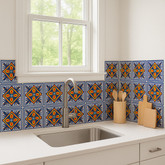
Mexican Pattern Tiles for Hacienda Style Kitchens and Bathrooms
Mexican pattern tiles are a natural fit for Hacienda style kitchens and bathrooms because they bring together color, craftsmanship, texture, and architectural tradition. Hacienda interiors are rarely defined by a single decorative feature. Their character develops through the relationship between natural wood, textured plaster, stone, wrought iron, warm metals, handcrafted furniture, and colorful ceramics. Patterned Mexican tile contributes to this layered environment by introducing hand-painted detail without losing the warmth and authenticity that make Hacienda spaces so inviting.
In kitchens, Mexican pattern tiles can transform backsplashes, range walls, islands, and decorative borders into expressive architectural features. In bathrooms, they can bring personality to vanity backsplashes, mirror surrounds, niches, selected walls, and other appropriate surfaces. Designs can range from restrained blue-and-white compositions to vibrant combinations of cobalt, yellow, green, terracotta, and red.
The key to a successful Hacienda interior is not simply adding more decoration. It is combining materials thoughtfully so each element feels connected to the architecture. When Mexican pattern tiles are used with this principle in mind, they can help create kitchens and bathrooms that feel warm, handcrafted, established, and distinctly personal.
What Defines Hacienda Style?
Hacienda style draws inspiration from historic Mexican estates and homes where architecture responds to climate, local materials, craftsmanship, and everyday living. Although contemporary interpretations vary considerably, several characteristics frequently appear.
Textured plaster walls, substantial wood doors, exposed beams, stone, terracotta, wrought iron, courtyards, arches, handcrafted furniture, and decorative ceramic surfaces all contribute to the visual language.
Rather than emphasizing perfectly uniform finishes, Hacienda interiors often celebrate texture and material variation. Wood grain is visible. Stone displays natural movement. Iron can reveal handcrafted details. Ceramic tile contains variations created during painting, glazing, and firing.
Mexican pattern tiles therefore belong naturally within this design tradition.
Why Pattern Tiles Are Important in Hacienda Interiors
Hacienda interiors can contain substantial architectural materials. Heavy wood cabinetry, stone countertops, plaster walls, and iron details create warmth, but without color they can sometimes feel visually dense.
Pattern tile provides contrast. Cobalt blue, green, yellow, terracotta, white, and other ceramic colors can brighten darker materials and draw attention to important architectural areas.
Pattern also creates visual rhythm. A repeated floral design across a backsplash introduces structure, while mixed patterns create a more relaxed, collected appearance.
Used selectively, the tile can become the element that connects otherwise separate materials into a coherent composition.
Handmade Character Matters in Hacienda Design
A Hacienda-inspired room should not feel as though every component came from the same industrial production line. Part of its appeal comes from materials that reveal evidence of human craftsmanship.
Handmade Mexican pattern tiles naturally exhibit subtle differences in brushwork, glaze, dimensions, pattern placement, and color intensity. These variations distinguish artisan ceramic from mechanically printed material.
In a Hacienda interior, those differences are an advantage. They allow the tile to relate naturally to wood, stone, iron, plaster, and other surfaces that also contain variation.
Creating a Hacienda Kitchen Backsplash
The backsplash is one of the best locations for Mexican pattern tile in a Hacienda kitchen. It provides enough surface area to establish color and pattern while remaining visually connected to cabinetry, countertops, sinks, and cooking areas.
A single repeating pattern can create a more formal traditional appearance. Mixed tiles produce a relaxed and eclectic effect. Decorative borders can organize either approach.
Before choosing a layout, consider how much visual activity already exists in the cabinetry and countertop. A highly decorative kitchen may benefit from a controlled tile palette, while simpler cabinetry can support a more elaborate backsplash.
Create a Focal Point Behind the Range
The range wall naturally attracts attention and offers an excellent opportunity for decorative tilework. A central panel of Mexican pattern tiles can establish a focal point without requiring the entire backsplash to use the same elaborate design.
The panel can be surrounded by simpler field tiles or framed with a decorative border. This creates a clear hierarchy and allows the strongest pattern to occupy the most architecturally important location.
If the kitchen includes a handcrafted range hood, the tile panel can also help visually connect the cooking area from the countertop upward.
Mexican Pattern Tiles and Copper Range Hoods
Copper and Mexican ceramic create an especially appropriate combination for Hacienda kitchens. Copper introduces warmth, metallic depth, and handcrafted texture, while pattern tile provides contrasting color.
Cobalt blue can appear especially vivid against natural or aged copper. Greens and turquoise can establish an earthy relationship with the metal, while yellow, terracotta, and cream create a warmer overall palette.
When both the range hood and backsplash are visually strong, balance becomes essential. A highly detailed copper hood may work best with a more controlled tile composition, while a simpler hood shape can support a more elaborate mosaic or repeating pattern.
Pattern Tile with Rustic Wood Cabinetry
Wood cabinetry provides an ideal foundation for Hacienda style because it introduces warmth and architectural weight. Mexican tile can prevent large areas of wood from feeling overly dark or visually heavy.
Dark-stained cabinets create dramatic contrast with white, cobalt, yellow, and turquoise ceramic. Medium wood tones produce a softer traditional environment, while naturally distressed or rustic finishes emphasize the old-world character of the room.
The tile does not need to match the wood. Their contrast is part of what makes the combination effective.
Pairing Mexican Tile with Stone Countertops
Stone and handmade ceramic contribute different types of visual movement. Stone contains natural veining, tonal shifts, or mineral variation, while Mexican tile introduces deliberate pattern and color.
If the tile is highly detailed, a relatively restrained countertop often provides the strongest balance. If the backsplash uses a simpler repeating motif, a countertop with more natural movement may work comfortably beside it.
Instead of matching every color, look for one shared tone that connects the materials subtly.
Using Blue-and-White Tiles in a Hacienda Kitchen
Not every Hacienda kitchen needs an extensive multicolored palette. Blue-and-white Mexican pattern tiles can provide traditional character with greater visual restraint.
Cobalt blue offers strong contrast against wood, plaster, and stone, while white keeps the backsplash bright. The combination also pairs effectively with copper, brass, bronze-inspired finishes, and wrought iron.
Blue-and-white tile is particularly useful when the kitchen already contains several natural materials and the backsplash needs to provide pattern without adding too many additional colors.
Multicolored Tiles for a More Expressive Kitchen
For a more energetic Hacienda interior, multicolored pattern tiles can become the heart of the kitchen. Cobalt, green, yellow, red, terracotta, and white can create a rich decorative surface.
The strongest results usually maintain some visual discipline. Designers might repeat a small family of patterns, maintain a consistent background color, or use a border to contain the composition.
These organizing devices allow the kitchen to feel colorful without becoming visually uncontrolled.
Mixing Mexican Tile Patterns
Mixed patterns can create the impression that a room has developed over time rather than being assembled all at once. This quality works especially well in Hacienda interiors.
Floral tiles can sit beside geometric designs, while several traditional motifs repeat unpredictably across the wall. A shared palette keeps the installation connected.
Before installation, arrange representative tiles on a flat surface. This allows similar patterns and colors to be distributed throughout the backsplash instead of accidentally forming clusters.
Using Decorative Borders to Create Structure
Borders are useful when a Hacienda design contains several colors or patterns. They create visual boundaries and can make a highly decorative installation feel more architectural.
A border can frame a range panel, run along the top of a backsplash, separate two tile treatments, or define a decorative wall section.
It can also introduce a recurring color that connects the ceramic to cabinetry, countertops, or metal fixtures.
Mexican Pattern Tiles in Hacienda Bathrooms
The same qualities that make Mexican tile effective in Hacienda kitchens translate naturally to bathrooms. Pattern, color, and glazed ceramic provide contrast with wood vanities, stone countertops, plaster walls, mirrors, and metal fixtures.
A bathroom does not need to be completely tiled to establish Hacienda character. A carefully positioned backsplash, mirror surround, decorative wall, or niche can provide sufficient visual identity.
Selective use also allows handcrafted ceramic to remain special rather than becoming background texture.
Create a Colorful Vanity Backsplash
The vanity is one of the most visible areas in a bathroom, making it a natural location for pattern tile.
A backsplash can extend only a short distance above the countertop for a restrained effect or continue behind the mirror for greater impact. A single repeated pattern creates order, while mixed Mexican tiles produce a more artistic appearance.
Natural wood cabinetry beneath the tile can reinforce Hacienda warmth and provide a visual counterbalance to colorful ceramic.
Pairing Pattern Tiles with a Talavera Sink
A hand-painted Talavera sink can make the vanity even more distinctive. However, the sink and backsplash do not need to use the same design.
A more layered result often comes from coordinating colors rather than patterns. A basin containing cobalt, yellow, and green, for example, could be paired with predominantly blue-and-white pattern tiles.
The shared cobalt creates a relationship while allowing the sink to retain its identity as the primary focal point.
Using Pattern Tile Around a Mirror
A simple mirror can become an architectural feature when framed with Mexican pattern tiles. This approach requires relatively little tile but can create substantial visual impact.
A narrow border provides a restrained accent. A wider ceramic frame becomes more decorative and can establish the mirror as the central feature of the vanity wall.
Wrought iron, wood, or simple frameless mirrors can all work depending on the desired balance between tile and surrounding materials.
Decorative Bathroom Niches
Pattern tile can highlight recessed niches and prevent them from disappearing into the wall. Installing decorative ceramic on the back surface creates contrast and emphasizes architectural depth.
For niches exposed to substantial moisture, the decorative design must be supported by an installation system appropriate for the conditions. Suitable substrates, waterproofing, adhesives, and grout should be selected for the specific environment.
The beauty of the finished ceramic depends on correct preparation underneath it.
Pattern Tiles and Wrought Iron
Wrought iron is strongly associated with many Hacienda and Spanish-influenced interiors. Mirrors, lighting, cabinet hardware, and architectural details can provide dark linear contrast against colorful ceramic.
The combination works because the materials perform different visual roles. Talavera contributes color and detailed ornament, while iron introduces structure and definition.
A black or dark iron mirror positioned against a colorful Mexican tile wall can create a particularly strong focal point.
Warm Metal Fixtures in Hacienda Bathrooms
Brass and bronze-inspired fixtures can create a softer alternative to dark iron. Their warm tones complement natural wood and many traditional Talavera palettes.
Yellow, terracotta, green, cobalt, and white ceramics can all work successfully with warm metal faucets and hardware.
Fixture design should still respect the overall hierarchy. When the sink and backsplash are already highly decorative, simpler faucet forms may create a more balanced result.
Plaster Walls Provide Visual Breathing Room
Pattern tile becomes more expressive when surrounded by quieter surfaces. Textured plaster is particularly effective because it provides subtle handcrafted character without introducing another strong pattern.
Warm white, cream, beige, and earthy plaster tones can frame colorful ceramic while reinforcing Hacienda architecture.
This relationship demonstrates an important principle: traditional interiors do not need ornament on every surface. Contrast between simple and decorative areas often creates greater depth.
Terracotta and Mexican Pattern Tiles
Terracotta flooring can reinforce the warm foundation of a Hacienda kitchen or bathroom. Its earthy red and orange tones connect naturally with many Mexican tile palettes.
If the floor already contains substantial color variation, the wall tile can use a more controlled palette. Blue-and-white patterns, for example, create attractive contrast against warm terracotta.
Alternatively, small terracotta accents within a multicolored pattern can establish a subtle relationship between floor and wall.
Use Pattern Strategically in Small Hacienda Bathrooms
A small bathroom can support strong pattern when it is concentrated carefully. Rather than covering every wall, select one primary surface.
The vanity backsplash, mirror wall, or decorative niche can carry the pattern while plaster, stone, or a quieter tile treatment covers surrounding areas.
This strategy gives the room personality without sacrificing visual clarity.
Creating a Hacienda Powder Room
Powder rooms are particularly well suited to expressive Hacienda design. Their compact scale means a relatively small amount of tile can influence the entire space.
A colorful pattern backsplash combined with a wood vanity, Talavera sink, warm metal faucet, and wrought iron mirror can establish a complete design vocabulary within a very small footprint.
Because guests experience powder rooms for shorter periods, these spaces can also support stronger color choices than larger everyday bathrooms.
Use Pattern to Highlight Architectural Features
Mexican tile does not always need to cover conventional rectangular walls. It can emphasize architectural features such as arches, niches, selected borders, and framed panels where appropriate.
Using ceramic strategically can make these details more noticeable and reinforce the sense that the tile is integrated into the architecture.
This is particularly important in Hacienda design, where architectural character often matters more than surface decoration alone.
Handmade Variations Should Be Expected
Handmade Mexican tiles are not intended to reproduce the exact uniformity of industrially calibrated ceramic. Slight variations can occur in dimensions, glaze, color, brushwork, and pattern placement.
These differences are part of the artisan process. Once installed, they create subtle movement across the surface and help distinguish handmade tile from mechanically printed alternatives.
Rather than attempting to hide these variations, a thoughtful installation distributes them naturally throughout the design.
How Handmade Mexican Pattern Tiles Are Created
The character of Mexican pattern tile begins during production. Clay is prepared and formed into individual pieces before being allowed to dry. The tiles then undergo an initial kiln firing.
Decoration is applied by hand using brushes and pigments. Floral, geometric, and traditional motifs develop one piece at a time, which naturally introduces slight differences between tiles.
Glazing and additional firing develop the finished ceramic surface and colors. Heat can influence glaze and pigment, contributing further individuality to each production batch.
This process is fundamental to the visual character that makes handmade Mexican tile so appropriate for Hacienda interiors.
Plan the Tile Layout Before Installation
Before installing pattern tile permanently, review the actual pieces and plan the layout. This is particularly important for handmade ceramics because color and pattern variation should be distributed intentionally.
For repeating patterns, verify how motifs connect. For mixed designs, spread similar colors throughout the surface. Important focal areas such as the range wall or vanity should receive particular attention.
Planning also helps determine how patterns will terminate at corners, cabinets, mirrors, outlets, and other architectural elements.
Grout Is Part of the Hacienda Tile Design
Grout color can substantially influence how a pattern is perceived. A lighter grout may keep the installation bright and emphasize individual tile edges. A darker grout creates stronger definition. Neutral tones can allow the ceramic colors to remain dominant.
Because handmade tiles may exhibit dimensional variation, grout joints also contribute to accommodating the artisan character of the material.
The installer should select an approach appropriate for both the aesthetic goals and technical requirements of the project.
Balance Is More Important Than Perfect Matching
A convincing Hacienda interior rarely depends on every material matching precisely. In fact, excessive coordination can make a room feel artificial.
The stronger approach is to create relationships among materials. Cobalt in the tile can relate to a Talavera sink. Terracotta accents can connect with flooring. Warm metals can echo yellow tones. Wood can provide a neutral foundation for the entire palette.
These connections allow the kitchen or bathroom to feel collected and layered rather than designed from a single matching set.
Mix Old-World Character with Modern Function
A contemporary Hacienda-inspired kitchen or bathroom can retain modern functionality while using traditional decorative materials.
Modern appliances, efficient lighting, contemporary plumbing fixtures, and practical cabinetry can coexist with hand-painted tile, wood, stone, and iron.
The contrast can actually make the handcrafted elements more noticeable. Traditional Mexican tile becomes a source of warmth within an otherwise streamlined environment.
Caring for Mexican Pattern Tiles
Routine care for glazed decorative tile should generally remain gentle. Warm water, mild soap, and a soft cloth or nonabrasive sponge can address much of the everyday residue encountered in kitchens and bathrooms.
Abrasive tools and unnecessarily aggressive cleaners should be avoided on decorative glazed surfaces. Grout should be maintained according to the requirements of the product used in the installation.
Consistent, gentle maintenance helps preserve the visual clarity of the hand-painted design.
Explore Mexican Pattern Tiles for Hacienda Interiors
Whether you are designing a full Hacienda-inspired home or simply want to introduce handcrafted Mexican character into a kitchen or bathroom, pattern tile can provide a strong architectural starting point. You can explore Mexican Tile Store for Mexican pattern tiles, Talavera ceramics, and decorative products for traditional and contemporary interiors.
Before choosing a design, consider the surrounding wood, stone, plaster, metal finishes, flooring, and other permanent materials. Selecting tile as part of this larger composition can produce a room that feels naturally layered rather than overly coordinated.
If you have questions about Mexican pattern tiles, product availability, or selecting ceramic for a Hacienda style kitchen or bathroom, you can contact our team for additional assistance.
Conclusion: Building Hacienda Character Through Color and Craftsmanship
Mexican pattern tiles work beautifully in Hacienda style kitchens and bathrooms because they share the same fundamental qualities that define the architecture: warmth, craftsmanship, material variation, and a strong connection to traditional decorative arts.
In the kitchen, they can transform a backsplash or range wall while complementing wood cabinetry, stone countertops, copper range hoods, and wrought iron. In the bathroom, they can give personality to a vanity, frame a mirror, highlight a niche, or coordinate with a hand-painted Talavera sink.
The most convincing Hacienda interiors do not depend on filling every surface with ornament. Instead, they combine expressive handcrafted elements with quieter natural materials. Pattern tile provides color where it matters, while wood, stone, plaster, terracotta, and metal establish the architectural foundation.
With thoughtful planning and an appreciation for the natural variations of artisan production, Mexican pattern tiles can help create Hacienda kitchens and bathrooms that feel colorful without being chaotic, traditional without feeling dated, and distinctive without losing the welcoming character that makes this style so enduring.