


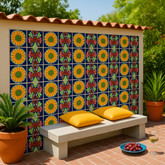
Pattern Tile Ideas for Kitchens, Bathrooms, Patios, and Fireplace Surrounds
Pattern tile can turn a practical surface into an architectural feature. In a kitchen, it can establish the palette of the room. In a bathroom, it can bring depth to a compact vanity or shower niche. Across a patio, it can connect the home to an outdoor entertaining area, while a tiled fireplace surround can give a living room a clear visual center.
The most successful installations are not simply the most colorful. They respond to the dimensions, lighting, materials, and function of the space. Pattern scale must suit the available area, grout should support the design, and the tile itself must perform under the conditions where it will be installed.
Mexican pattern tiles are especially versatile because they include geometric repeats, floral motifs, hand-painted Talavera designs, borders, murals, relief tiles, and solid-color coordinating pieces. These options can support Spanish Colonial, Hacienda, Mediterranean, rustic, transitional, and contemporary interiors.
Whether the project involves an expansive patio or a small backsplash, thoughtful planning allows pattern tile to introduce personality without creating visual confusion. The goal is a surface that feels designed for its location and remains satisfying long after temporary trends have changed.
Why Pattern Tile Has Such a Strong Design Impact
Tile combines practical protection with permanent visual expression. Unlike a rug, cushion, or framed print, a tiled surface becomes part of the architecture. This gives pattern tile greater authority within the room and makes placement particularly important.
Pattern creates movement by guiding the eye across a surface. Repeated geometry can make a wall appear wider, while vertical arrangements can emphasize height. Floral patterns soften hard materials, and borders create visual boundaries around focal areas.
Color adds another layer. A patterned tile may connect wood cabinetry to a stone counter, repeat the blue of a nearby fabric, or introduce warmth into a room dominated by white and gray. Because several colors can appear within one motif, the tile can serve as the foundation for the complete material palette.
Handmade Mexican tiles add subtle variations in glaze, brushwork, and tone. These differences prevent a repeated pattern from appearing flat or mechanical. The overall design remains ordered, but the individual pieces reveal evidence of the artisan and firing process.
How to Choose the Right Pattern for Each Space
Begin by considering how far the viewer will be from the tile. Small, detailed motifs work well on kitchen backsplashes, vanity walls, and stair risers because they are seen at close range. Larger geometric patterns remain legible across patios, full fireplace walls, and broad architectural panels.
Next, determine whether the surface will be the primary focal point. A room with quiet cabinets, simple counters, and neutral walls can support a detailed multicolor pattern. If the space already contains heavily veined stone, ornate furniture, or elaborate textiles, a limited palette or smaller tile feature may create better balance.
The shape of the installation also affects pattern selection. A tall, narrow fireplace may need a different repeat from a long kitchen backsplash. A small shower niche should use a pattern that remains recognizable after cuts, while a large patio can accommodate designs formed across several tiles.
Finally, consider maintenance and exposure. The pattern may be visually suitable, but the tile body, glaze, slip resistance, water absorption, and setting system must also be appropriate for the intended location.
Pattern Tile Ideas for Kitchen Backsplashes
Kitchens contain many visually substantial elements: cabinets, appliances, counters, hardware, lighting, and flooring. A patterned backsplash can unite these pieces, but it needs a defined role within the design.
Create a Full Patterned Backsplash
A full patterned backsplash is most effective when cabinetry and countertops are relatively restrained. White, cream, muted green, dark wood, or natural-finish cabinets can all provide a suitable background for Mexican tile.
Blue-and-white patterns create crisp contrast and work well with both warm and cool neutrals. Multicolor Talavera designs bring more energy and are particularly compatible with Spanish, Hacienda, and Mediterranean kitchens.
Before choosing a detailed pattern, evaluate the countertop. Strong veining and movement can compete with intricate tile. A quieter counter—such as lightly patterned stone, concrete, or a solid surface—allows the backsplash to become the clear focal point.
Frame the Area Behind the Range
A decorative panel behind the range provides impact without covering every backsplash wall. Patterned tiles can be framed with a border and surrounded by solid-color field tile.
This layout creates symmetry and makes the cooking area feel architecturally important. It is also useful when a client wants handmade tile but prefers to concentrate the project budget in one highly visible location.
Align the panel with the range and hood rather than with unrelated cabinet seams. Plan its height carefully so the border is not interrupted by a pot filler, shelf, or decorative hood detail.
Mix Coordinating Patterns
A mixed-tile backsplash can create the appearance of a collected installation. Select several designs that share a background color or repeat a limited group of pigments.
Lay the tiles on a flat surface before installation. Distribute dominant colors evenly and avoid placing nearly identical motifs next to one another unless deliberate repetition is part of the plan.
This approach works particularly well in Hacienda and eclectic kitchens. For a more contemporary result, combine fewer patterns and restrict the palette to two or three colors.
Use Pattern on a Kitchen Island
The vertical face of an island or peninsula offers a less conventional location for patterned tile. It is especially effective on the side facing a dining or living area, where the design remains visible without interfering with food preparation.
Island tile should relate to the backsplash without necessarily matching it. A solid-color backsplash can support a patterned island, or one accent color can connect two different tile arrangements.
Pattern Tile Ideas for Bathroom Walls and Vanities
Bathrooms can support expressive surfaces because their smaller dimensions create a contained design environment. Pattern should still be used strategically so fixtures, mirrors, lighting, and tile remain visually organized.
Design a Statement Vanity Wall
A patterned wall behind the vanity can define the room immediately. Tile may extend from the countertop to the mirror, cover the complete wall, or form a framed backsplash.
For a small powder room, a full patterned wall creates drama without requiring a large quantity of material. In a primary bathroom, using pattern only at one vanity can establish a focal point while leaving shower and floor surfaces quieter.
Consider how the mirror will cover the motif. A large central design may disappear behind it, whereas a consistent repeat remains visible around the edges.
Add Pattern Inside a Shower Niche
A tiled niche is an effective place for a concentrated accent. The surrounding shower can use simple field tile, allowing the patterned back panel to stand out.
Select a motif appropriate to the niche dimensions. Designs formed across four or more tiles may be difficult to read in a small opening. A compact repeat or individual decorative tile usually adapts more successfully.
Confirm that the tile and installation system are suitable for wet areas. Waterproofing, edge finishing, slope, adhesive, grout, and sealants are part of the installation’s performance.
Create a Decorative Wainscot
A patterned tile wainscot can wrap a powder room or bathroom at a controlled height. A border provides a finished transition to plaster or painted wall above.
Continuous multicolor pattern can feel visually dense in a small room. One solution is to use solid-color tile as the main field and introduce patterned pieces at regular intervals. Another is to use pattern below and keep the upper walls and ceiling neutral.
Frame a Mirror or Architectural Opening
Narrow border tiles can frame a mirror, window, doorway, or recessed cabinet. This application introduces color without requiring a broad tiled surface.
Corner pieces should be planned in advance. If a border has a directional motif, improvised corner cuts may disrupt the pattern. Verify the availability and dimensions of coordinating trim before finalizing the layout.
Pattern Tile Ideas for Bathroom Floors
A patterned bathroom floor can give the room a strong foundation, especially when the walls are simple. However, not every decorative tile is manufactured for floor use.
Confirm that the selected product offers suitable durability and slip resistance for the intended area. A hand-painted wall tile should not automatically be placed on a bathroom or shower floor simply because its pattern is attractive.
For floor-rated pattern tile, consider how the repeat will meet walls, vanities, tubs, and door thresholds. Centering a pattern in the visible area may produce more balanced cuts along the perimeter.
If the floor is visually active, keep wall tile and shower surfaces restrained. Solid-color tile, plaster-like finishes, or simple stone can support the floor without creating competition.
Pattern Tile Ideas for Patios and Outdoor Living Areas
Patios offer more space for pattern, but outdoor conditions add technical demands. Sunlight, temperature changes, moisture, standing water, and freeze-thaw cycles can all affect the installation.
Define an Outdoor Dining Area
Pattern tile can create a visual “rug” beneath an outdoor dining table. A decorative field framed by a solid border defines the gathering area without using fabric that must be stored or replaced.
The composition should be sized to extend beyond the table and chairs. If chair legs repeatedly cross the border, the area may feel too small. A scaled plan helps determine the correct dimensions before installation.
Add Tile to an Outdoor Kitchen
An outdoor kitchen backsplash or counter face provides a durable location for decorative tile. Pattern can distinguish the cooking area from the rest of the patio and connect it to colors used inside the home.
Vertical surfaces are generally less demanding than exposed horizontal counters because they are less likely to collect standing water. Nevertheless, tile suitability, substrate preparation, setting materials, and climate exposure must still be evaluated.
Highlight Built-In Benches and Planters
Tile can be applied to the face or back of a built-in bench, planter box, or low courtyard wall. These applications introduce pattern at eye level when people are seated and help integrate furnishings with the architecture.
Use borders or solid-color trim to finish exposed edges. The seat itself may require a quieter and more comfortable material, leaving patterned tile for vertical surfaces.
Create a Courtyard Fountain
Blue, white, green, and turquoise patterns are naturally associated with water and can make a fountain the focal point of a patio. Multicolor Mexican tiles create a warmer and more expressive Hacienda character.
Fountain installations require products and systems designed for continuous water exposure. Waterproofing, movement accommodation, chemical exposure, mineral deposits, and maintenance should all be considered before specifying the tile.
Design a Patterned Staircase
Outdoor stair risers can connect a terrace, courtyard, or entry to the home’s architectural style. Alternating patterns create variety, while repeating one motif produces a more formal sequence.
Treads require appropriate traction and wear performance. Patterned wall tile is best reserved for risers unless it is specifically rated for floor and exterior use.
Pattern Tile Ideas for Fireplace Surrounds
A fireplace is already an architectural focal point, making it one of the most effective places to use decorative tile. The tile can influence the style of the entire room without requiring a large installation.
Tile the Complete Surround
Covering the area around the firebox with one repeated pattern creates a cohesive statement. Geometric designs give the fireplace structure, while floral Talavera patterns add softness and color.
The width of the surround should accommodate complete or balanced tile cuts. Narrow strips at the outer edges can weaken the composition, so a scaled elevation is useful before materials are ordered.
Create a Framed Central Panel
A patterned panel above the mantel can function almost like permanent artwork. It may feature repeating tiles, a mural, or a medallion assembled from several pieces.
Frames can be created with ceramic borders, stone, wood, or plaster moldings. The selected frame should relate to the room’s other architectural details and provide enough separation between the tile and nearby artwork.
Combine Pattern with Solid-Color Tile
Solid tile can give complex motifs breathing room. Use patterned pieces directly around the firebox and a coordinating solid color above, or reverse the arrangement to create a decorative upper panel.
This approach allows strong color to be introduced without making the entire fireplace visually dense. It can also help manage the project budget while preserving handmade tile at the most visible points.
Use Pattern on the Hearth with Care
A tiled hearth can continue or contrast with the surround, but the material must be appropriate for foot traffic, impact, heat, and applicable construction requirements. Decorative wall tile should not be assumed suitable.
The complete fireplace assembly matters. Substrate, clearances, setting material, grout, and tile performance must match the temperatures and conditions specified for the project.
Choosing Between Geometric, Floral, and Mixed Patterns
Geometric patterns create order. Stars, diamonds, interlocking circles, and angular repeats can make traditional architecture feel structured and contemporary rooms feel more tactile. Two-color geometry tends to look restrained, while multicolor designs produce stronger movement.
Floral and botanical motifs create a softer impression. They work well in kitchens, garden rooms, bathrooms, and courtyards where the pattern can relate to natural materials or outdoor views.
Mixed-pattern compositions feel collected and informal. They are particularly compatible with Hacienda, bohemian, and eclectic interiors. A shared background or limited color palette keeps the arrangement coherent.
Relief patterns rely on shadow as well as color. Dimensional tiles can be effective on fireplace surrounds and accent walls where directional light reveals the raised surface. Deep relief may require more cleaning than flat tile, so placement should account for maintenance.
Coordinating Pattern Tile with Other Materials
Pattern tile should have a clear relationship with the room’s permanent materials. Wood brings warmth and helps colorful ceramic surfaces feel grounded. Plaster provides a quiet matte background, while stone can introduce natural variation without repeating the tile’s ornament.
Countertops require particular attention. Strongly veined slabs can compete with detailed patterns. If both materials are important, select a tile with a limited palette or place it in a contained panel rather than across the entire wall.
Metal finishes can repeat smaller tile colors. Black iron relates to dark painted outlines, brass complements yellow and warm glazes, and copper supports terracotta or orange pigments.
Textiles and artwork should not duplicate every pattern in the tile. Use solid fabrics, broad stripes, or larger-scale motifs to create contrast. An overly exact match can make the interior feel staged rather than naturally layered.
The Importance of Grout Color
Grout is a visible part of every patterned installation. A color close to the tile’s background softens the grid and allows the painted design to remain dominant. This is often the safest option for intricate Mexican patterns.
Contrasting grout emphasizes each tile edge. It can strengthen simple geometry but may interrupt floral motifs or make a multicolor composition feel crowded.
Do not select grout from a small printed chart alone. Test a sample beside the actual tile and surrounding materials. Handmade glaze may respond differently to grout pigments and cleaning methods, so installation guidance should be reviewed before work begins.
Joint width also influences the composition. Artisan tiles may vary slightly in size and shape, requiring flexible spacing. An installer familiar with handmade tile can maintain overall alignment while accommodating those differences.
Planning the Layout Before Installation
Determine whether the motif has a fixed direction. Some patterns can be rotated freely, while others create a larger image only in one orientation. Marking or organizing directional tiles before installation reduces errors.
Dry-lay several rows to review color distribution and pattern flow. For handmade tiles, open multiple boxes and mix pieces so natural variation appears throughout the surface.
Plan cuts around outlets, plumbing, windows, cabinetry, and corners. Whenever possible, place full motifs at major focal points and move less noticeable cuts toward edges.
Borders, trim, and corner pieces must be incorporated into the dimensions from the beginning. Their sizes may differ from the field tile and alter the location of the central pattern.
Ordering Pattern Tile for the Project
Measurements should include overage for cuts, selection, installation damage, and future repairs. The appropriate quantity depends on the complexity of the layout.
Straight rectangular fields generally require less overage than diagonal designs, murals, mixed patterns, bordered panels, stair risers, and surfaces with numerous interruptions. Directional patterns may generate offcuts that cannot be reused elsewhere.
Order the complete quantity at one time whenever possible. Handmade tiles can vary between firing and production batches. A later order may not match the original glaze or pigment range precisely.
Keep several unused pieces after the installation. Matching a discontinued design or earlier batch can be difficult if a repair becomes necessary years later.
Why Handmade Craftsmanship Matters
Handmade Mexican tile carries visual qualities created through a physical process. Clay must be prepared and formed, dried carefully, fired, glazed, decorated, and fired again. Each stage affects the dimensions, surface, color, and durability of the finished piece.
Artisans learn how pigments change in the kiln, how glaze collects around painted lines, and how much variation a repeated design can support. The tiles are similar enough to form a coherent pattern but individual enough to reveal the hand behind them.
These differences are particularly visible across backsplashes, fireplace surrounds, and other areas viewed closely. Instead of a perfectly duplicated printed image, the surface contains subtle shifts that give the pattern depth.
Craftsmanship also adds long-term design value. A well-chosen handmade tile installation is not dependent on a temporary color trend. It becomes an architectural feature connected to material knowledge and an established decorative tradition.
Explore Pattern Tiles for Your Next Project
The right pattern depends on where the tile will be installed, how it will be viewed, and which materials surround it. Comparing physical samples and planning the layout early can clarify whether the project needs a full patterned field, a framed feature, a mixed arrangement, or a smaller accent.
Explore Mexican pattern tiles, Talavera designs, borders, murals, solid colors, and coordinating pieces at Mexican Tile Store. The available options can inspire kitchens, bathrooms, patios, fireplaces, stair risers, fountains, and other architectural surfaces.
For assistance with product selection, quantities, coordinating components, or application requirements, contact Mexican Tile Store before ordering. Early guidance helps connect the creative plan with the practical needs of the installation.
Conclusion
Pattern tile can change how a room or outdoor area is experienced. It can establish a focal point, clarify an architectural feature, connect a color palette, or introduce craftsmanship into a space dominated by standardized surfaces.
Kitchens benefit from backsplashes and range panels designed around cabinetry and counters. Bathrooms offer controlled opportunities at vanities, niches, and wainscoting. Patios can use pattern to define dining areas, fountains, benches, and outdoor kitchens. Fireplace surrounds provide a natural frame for decorative compositions.
The strongest installation is not necessarily the largest or most colorful. It is the one in which pattern scale, placement, material performance, grout, and surrounding finishes have been considered together.
By choosing tile appropriate to the application and developing the layout before installation, homeowners and designers can create surfaces that feel expressive without becoming excessive. Handmade Mexican pattern tile adds another level of value through subtle variation, material depth, and the visible contribution of the artisan—qualities that make each finished project genuinely individual.