


Relief Tiles: Their Creation and Role in Design from Antiquity to the Present Day
Relief tiles occupy a distinctive place between architecture, sculpture, and decorative art. Unlike flat tiles, their raised or recessed surfaces interact with light, producing shadows that change throughout the day. This dimensional quality can transform a wall, fireplace, fountain, or façade into an architectural feature with depth and visual rhythm.
Although relief tiles feel especially relevant to contemporary interiors, their history reaches back thousands of years. Ancient civilizations used molded and carved surfaces to decorate temples, palaces, civic buildings, and ceremonial spaces. Over time, artisans refined the materials, molds, glazes, and firing methods used to create them. Designers continue to draw from this heritage, applying relief tiles to settings ranging from Mediterranean courtyards and Spanish Colonial homes to refined kitchens and modern hospitality spaces.
Understanding how these tiles are made—and how their dimensional surfaces affect an installation—helps homeowners, architects, and interior designers make more informed choices. The most successful applications respect the material, the craftsmanship behind it, and the architectural context in which it will be placed.
What Are Relief Tiles?
Relief tiles are ceramic, terracotta, stone, or cement units featuring designs that project above or sink below the background surface. A raised design is known as bas-relief or low relief when the projection is shallow. More pronounced forms may be described as high relief. Recessed patterns are sometimes called sunken relief.
The design may be geometric, floral, figurative, heraldic, or abstract. Some relief tiles form complete individual compositions, while others are modular pieces intended to create a continuous pattern across a larger surface. Borders, corner tiles, medallions, and repeating field tiles can be combined into carefully structured installations.
Dimension is what separates relief tile from conventional decorative tile. Color remains important, but the surface itself contributes to the composition. Light striking an embossed motif creates highlights on raised areas and shadows in recesses. As natural or artificial lighting changes, the tile can appear subtly different.
This interaction makes relief tile particularly effective in spaces that benefit from material richness. Even a restrained monochromatic installation can command attention because the pattern is revealed through texture rather than through contrasting colors alone.
The Ancient Origins of Architectural Relief
The use of dimensional ceramic surfaces can be traced to some of the earliest urban civilizations. In ancient Mesopotamia, molded and glazed bricks decorated monumental buildings. The Ishtar Gate of Babylon, constructed during the reign of Nebuchadnezzar II in the sixth century BCE, is among the best-known examples. Its blue-glazed surface featured raised representations of lions, bulls, and mythical creatures arranged across an imposing architectural composition.
These elements did more than embellish a structure. They communicated political authority, religious symbolism, and civic identity. Because molded components could be repeated, craftspeople were able to develop extensive decorative programs while maintaining consistency across large walls.
Ancient Egyptian builders also incorporated relief into temples and funerary architecture. Although much Egyptian relief was carved directly into stone, its visual principles influenced later architectural ornament: controlled depth, symbolic imagery, orderly repetition, and careful integration with a building’s proportions.
Greek and Roman traditions expanded the role of terracotta architectural elements. Molded plaques, roof ornaments, antefixes, and friezes were used on temples, villas, and public buildings. Reusable molds allowed workshops to reproduce decorative motifs with greater efficiency. Roman craftspeople also understood the practical value of fired clay as a durable architectural material that could be shaped before installation.
Across these cultures, relief was never merely surface decoration. It helped define entrances, organize façades, frame significant spaces, and preserve visual narratives. Those functions remain relevant in contemporary tile design.
Relief Tiles in Islamic, Moorish, and European Design
Islamic art developed exceptionally sophisticated systems of architectural ornament. Geometry, calligraphy, vegetal forms, and repeated patterns were used to articulate walls without depending on figurative imagery. Carved stucco, molded ceramics, and glazed tilework often appeared together, creating interiors rich in texture and carefully controlled repetition.
In medieval Spain, the convergence of Islamic, Christian, and Jewish artistic traditions produced distinctive decorative languages. Moorish architecture demonstrated how patterned surfaces could reshape the perception of a room. Tile was used to establish order at a human scale, often covering lower walls while carved plasterwork or timber ceilings occupied the areas above.
European Renaissance workshops continued to explore molded and glazed ceramics. Relief panels and architectural components appeared on façades, altarpieces, fireplaces, and devotional objects. Italian ceramicists, including the renowned Della Robbia workshop, demonstrated the expressive potential of glazed terracotta relief. Their work combined sculptural modeling with surfaces that were luminous, durable, and comparatively resistant to moisture.
In Spain and Portugal, decorative tile became central to both secular and religious interiors. Not all historic tiles were dimensional, but relief techniques contributed to borders, repeating motifs, and architectural accents. These traditions later traveled across the Atlantic, where they encountered Indigenous materials, symbols, and methods.
The Development of Relief Tile in Mexico
Mexican tilemaking reflects centuries of cultural exchange. Spanish ceramic traditions introduced during the colonial period merged with established Indigenous knowledge of clay, mineral pigments, and firing. The resulting work was neither a simple copy of European tile nor a continuation of pre-Hispanic ceramics. It became a distinctive material culture shaped by local resources and regional craftsmanship.
Puebla emerged as an important center for glazed earthenware and Talavera production. Other regions developed their own ceramic identities, with variations in clay composition, imagery, glazing, and firing. Relief tiles became suitable for religious buildings, haciendas, fountains, kitchens, courtyards, stair risers, and ornamental façades.
Mexican relief designs may incorporate flowers, leaves, scrollwork, crosses, animals, stars, geometric forms, or motifs influenced by Spanish Colonial and Moorish ornament. Contemporary makers also produce cleaner, more abstract patterns suited to modern architecture.
The enduring appeal of Mexican relief tile comes partly from its balance of structure and individuality. A mold establishes the basic design, yet hand-finishing, glazing, and firing can leave subtle variations. These differences give an installation a crafted character that mechanically perfect surfaces rarely achieve.
How Relief Tiles Are Created
The production method varies according to the type of clay, the depth of the design, the desired finish, and the scale of the workshop. Most ceramic relief tiles nevertheless pass through several essential stages.
Designing the Motif
The process begins with a drawing, carved model, digital design, or sculpted prototype. The artist must consider more than the appearance of the pattern on paper. Fine lines may disappear beneath glaze, while steep projections can trap air, dry unevenly, or become vulnerable to chipping.
A strong relief design accounts for clay shrinkage during drying and firing. It also anticipates how tiles will meet at the edges. If the motif is intended to repeat, transitions must align from one unit to the next. Border and corner pieces require separate planning so the final installation appears deliberate.
Creating the Master and Mold
Once the design is resolved, a master model is produced. Traditional masters may be carved from plaster, wood, or clay. Contemporary studios may also use computer modeling and precision fabrication, especially for custom architectural commissions.
A negative mold is made from the master. Plaster is commonly used because it captures detail and draws moisture from clay. The mold must release the tile cleanly without damaging raised areas. Complex or deep designs may require multipart molds or adjustments that make removal easier.
Forming the Tile
Clay can be pressed into the mold by hand or with mechanical assistance. Pressure must be distributed evenly so the material reaches every recess without creating weak areas. The back of the tile is leveled and may be scored or textured to improve its bond with the setting material.
Some relief tiles are slip-cast rather than pressed. In this method, liquid clay is poured into a porous mold. The mold absorbs water, leaving a clay layer against its surface. Slip casting can capture detailed forms, although it requires careful control of thickness and drying.
Drying and Refining
Freshly formed tiles contain considerable moisture and cannot be fired immediately. They must dry gradually and evenly. If one area dries faster than another, the tile may warp or crack. Relief makes this stage more demanding because projecting details and the tile body can have different thicknesses.
After partial drying, an artisan may clean the edges, sharpen details, remove mold seams, or correct small imperfections. This hand-refining stage often distinguishes a carefully made tile from a mass-produced imitation.
Bisque Firing, Glazing, and Final Firing
Many ceramic tiles receive an initial bisque firing that hardens the clay while leaving it porous enough to accept glaze. Glaze may then be brushed, poured, sprayed, dipped, or applied selectively to emphasize parts of the relief.
During the final firing, glaze melts and bonds with the ceramic body. Heat can produce subtle shifts in color, gloss, and texture. Raised portions may receive a thinner glaze coating, while recesses collect more glaze and appear darker. This natural variation can strengthen the dimensional effect.
Some relief tiles are left unglazed to showcase the warmth of terracotta. Others receive matte, satin, crackled, or glossy finishes. The correct choice depends on the setting, exposure to water, maintenance expectations, and desired architectural character.
Why Craftsmanship Matters
A relief tile may look simple after installation, but its quality depends on decisions made throughout production. The clay must suit the intended environment. The mold must reproduce the design clearly. Drying must be controlled, and firing schedules must accommodate differences in thickness.
Experienced artisans understand how material behavior affects the finished piece. They know where a projecting detail needs reinforcement, how much definition a glaze may obscure, and how to preserve the rhythm of a repeating pattern. This knowledge is acquired through testing and repeated practice.
Variations in handmade tile should be evaluated thoughtfully. Small differences in shade, surface, dimensions, and glaze distribution are often evidence of the production method rather than defects. They allow the installation to feel animated and authentic. Excessive warping, structural cracks, unstable glaze, or poorly resolved edges, however, can signal inadequate manufacturing controls.
For important projects, sourcing tiles from a specialist supplier provides access to practical guidance as well as the product itself. The ability to discuss samples, quantities, trim pieces, installation conditions, and lead times is particularly valuable for custom or dimensional tilework.
Using Relief Tiles in Contemporary Interior Design
Relief tile is adaptable, but it performs best when used with a clear visual purpose. Its texture naturally attracts attention, so placement should support the architecture rather than compete with every other surface.
Kitchen Backsplashes
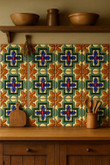
A relief backsplash can add depth to a kitchen dominated by smooth cabinets, stone counters, and metal appliances. Subtle geometric or botanical patterns work especially well behind a range or on a focal wall. A quieter field tile can be used elsewhere to prevent the room from becoming visually crowded.
Glazed surfaces are generally easier to clean around cooking areas. Deeply recessed designs may require more maintenance than shallow relief, particularly near grease and steam. Samples should be viewed under the kitchen’s actual lighting because directional light can make the pattern appear more dramatic.
Fireplace Surrounds
Fireplaces provide a natural frame for decorative tile. Relief tiles can define the opening, form a full-height chimney feature, or create an ornamental panel above the mantel. Traditional motifs support Spanish Colonial, Mediterranean, Arts and Crafts, and rustic interiors, while monochromatic reliefs can complement modern rooms.
The tile body, glaze, adhesive, and substrate must be appropriate for the expected heat conditions. Local building requirements and manufacturer recommendations should always guide material selection.
Bathrooms and Powder Rooms
Dimensional tile can turn a compact powder room into a memorable space. A relief wall behind a vanity offers visual impact without requiring additional furnishings. In larger bathrooms, relief can highlight a niche, tub wall, or dry vanity area.
Not every dimensional tile is suitable for shower floors or continuously submerged locations. Pronounced textures may be uncomfortable underfoot and more difficult to clean. Confirm the tile’s intended use, water absorption, glaze characteristics, and sealing requirements before specifying it for wet areas.
Courtyards, Fountains, and Exterior Features
Relief tiles have a strong architectural presence outdoors, particularly in courtyards and covered patios. They can be used on stair risers, wall panels, planters, fountain surrounds, and entry features. Sunlight reveals the depth of the pattern, often creating stronger shadows than indoor lighting.
Exterior suitability depends on climate and tile construction. Freeze-thaw exposure, standing water, direct sunlight, and thermal movement can affect performance. An exterior installation should use compatible setting materials, movement joints, drainage, and a substrate designed for the environment.
Commercial and Hospitality Spaces
Restaurants, hotels, boutiques, and reception areas often use relief tile to establish identity. A custom pattern can connect an interior to regional history or repeat a brand-inspired motif without relying on printed signage. Because tile is integrated into the architecture, it can create a more enduring impression than temporary décor.
Planning a Successful Relief Tile Installation
Dimensional tiles require more preparation than standard flat tile. Begin by confirming nominal and actual dimensions. Handmade tiles may vary slightly, so installers often adjust joint widths to maintain alignment and preserve the overall pattern.
Order samples before committing to a full installation. A photograph cannot fully communicate scale, glaze depth, edge profile, or shadow. Place samples vertically under daylight and evening illumination. If the tile will be installed near cabinetry, stone, paint, or wood, compare all materials together.
Plan the layout from the principal sightline. Avoid placing narrow cuts at prominent edges or interrupting an important motif. Dry-laying several pieces makes it possible to distribute color and surface variation across the installation. It also reveals whether repeating reliefs need a specific orientation.
Grout color has a significant effect. Matching grout creates a unified surface and allows the relief itself to lead. Contrasting grout emphasizes every tile boundary and may make an intricate installation feel busier. Grout must also be removed carefully from recesses before it cures.
Allow for a reasonable overage to cover cuts, selection, breakage, and future repairs. Projects with complicated layouts or handmade components may need more overage than simple rectangular fields. Ordering the full quantity at one time improves the likelihood of receiving a visually cohesive production batch.
Choosing Relief Tiles for a Specific Design Style
For traditional interiors, consider motifs with historical references, such as quatrefoils, arabesques, rosettes, scrolls, or botanical forms. Warm terracotta bodies and richly varied glazes can reinforce the material character of Spanish Colonial, Mexican, Mediterranean, and hacienda-inspired spaces.
Transitional interiors benefit from simplified historical patterns. A familiar motif rendered in a single neutral glaze can bridge classic architecture and contemporary furnishings. The dimensional surface supplies ornament without requiring a broad palette.
Modern spaces often favor repeated linear, fluted, faceted, or abstract forms. White, charcoal, sand, and deep green glazes allow shadows to define the pattern. Used on one carefully selected wall, these tiles introduce tactility while maintaining visual discipline.
The goal is not to match every element in the room. A successful selection creates a relationship between the tile and one or two architectural details—perhaps the curve of an arch, the geometry of cabinetry, the color of natural stone, or the finish of aged metal.
From Ancient Symbol to Modern Architectural Surface
Relief tiles have endured because they satisfy both practical and expressive needs. They divide large walls into a human scale, introduce durable ornament, and respond beautifully to light. Their production can preserve regional craft traditions while supporting contemporary design requirements.
Modern technology has expanded what is possible. Digital modeling can help develop complex repeats, precision equipment can improve mold consistency, and advanced glazes can produce a wide range of finishes. Yet the essential process remains rooted in an ancient sequence: shaping earth, controlling moisture, applying heat, and using the finished object to give architecture meaning.
This continuity is part of the material’s value. A relief tile installation does not simply follow a decorative trend. It participates in a long tradition of using dimensional surfaces to mark entrances, frame gathering places, enrich ceremonial settings, and bring craftsmanship into everyday life.
Explore Relief Tile Options for Your Project
Selecting dimensional tile is easier when the design, application, and installation requirements are considered together. Whether the project involves a kitchen backsplash, fireplace surround, courtyard fountain, bathroom feature, or commercial interior, the right tile should offer an appropriate balance of visual depth, material performance, and architectural relevance.
Explore the tile collections and design possibilities available from Mexican Tile Store. For questions about product selection, quantities, custom applications, or project requirements, contact the Mexican Tile Store team for guidance before placing an order.
A considered consultation can help identify suitable patterns, finishes, complementary field tiles, and trim components. It can also reduce avoidable installation challenges by addressing dimensions, placement, and environmental conditions during the planning stage.
Conclusion
Relief tiles connect some of the earliest forms of architectural decoration with the priorities of contemporary design. From molded bricks in ancient Mesopotamia and Roman terracotta ornaments to Moorish pattern, European glazed relief, and Mexican ceramic traditions, dimensional tile has continually evolved without losing its fundamental relationship to material and light.
Its creation demands more than pressing clay into a decorative mold. Designers and artisans must account for shrinkage, drying, firing, glaze behavior, structural strength, pattern continuity, and installation. These technical considerations are inseparable from the tile’s beauty.
Used thoughtfully, relief tiles can give a surface hierarchy, texture, and a lasting sense of place. The strongest installations do not depend on excessive ornament. They place a well-made material where its depth can be appreciated and where its design strengthens the surrounding architecture.
For homeowners and design professionals seeking an alternative to anonymous flat surfaces, relief tile offers something substantial: an architectural finish shaped by history, craftsmanship, and the movement of light. Exploring authentic designs and planning their use carefully can result in a space that feels distinctive at first glance and remains rewarding over time.