


Why Interior Designers Use Handmade Talavera Tiles to Create One-of-a-Kind Spaces
Memorable interiors are rarely defined by expensive furnishings alone. Their character usually comes from a clear design point of view, thoughtful material choices, and architectural details that could not simply be transferred to another property. Handmade Talavera tiles give interior designers a powerful way to create that distinction.
Each tile combines color, pattern, glaze, and visible craftsmanship. Small differences in brushwork and firing prevent an installation from feeling mechanically uniform, while a wide range of motifs allows designers to develop compositions suited to the scale and history of a particular room. Talavera tiles can become a kitchen’s primary focal point, bring rhythm to a staircase, frame a fireplace, or add an unexpected layer of color to a restrained bathroom.
Designers value these tiles not only for their decorative appeal but also for their ability to connect a project’s materials, architecture, and narrative. Used with intention, they can make a new home feel established, give a renovation a stronger sense of place, or introduce human character into an otherwise polished interior.
The result is not merely a colorful surface. It is a permanent architectural feature shaped for the people who will use the space.
Original Interiors Begin with Material Character
Many commercially available interior products are designed for broad compatibility. Neutral finishes, standardized dimensions, and consistent surfaces make them easy to specify, but they can also make unrelated projects look surprisingly similar.
Interior designers often counter this uniformity by selecting materials that possess their own character. Natural stone has veining, wood has grain, hand-applied plaster has movement, and artisan tile shows evidence of forming, glazing, painting, and firing. These variations help a room feel layered rather than assembled from a catalog.
Handmade Talavera tiles are especially effective because they combine material variation with deliberate ornament. They are not simply irregular versions of a solid-color tile. Each piece participates in a larger composition through painted lines, repeating geometry, floral imagery, borders, or color relationships.
This gives designers two levels of control. They can choose the overall pattern and palette while allowing subtle handmade differences to animate the finished surface. The installation feels coordinated without becoming sterile.
What Makes Handmade Talavera Tiles Distinctive?
Talavera is associated with a historic tradition of glazed earthenware in Mexico, especially in Puebla and surrounding areas. Its development reflects the interaction of European ceramic methods, Islamic decorative influence, and Indigenous knowledge of clay, pigments, and firing.
Traditional designs often include cobalt blue, green, yellow, orange, black, and soft white or ivory backgrounds. Floral medallions, scrolling foliage, stars, geometric repeats, animals, and decorative borders form part of the visual vocabulary.
The broader tile market also uses “Talavera” to describe Mexican hand-painted tiles inspired by this tradition. Production methods and origin can vary, so designers should clarify whether a project requires formally certified Talavera ceramics, handmade Mexican decorative tiles, or Talavera-style products.
Regardless of classification, the most compelling handmade tiles reveal the production process. Brush lines may vary slightly, glaze can collect around parts of a motif, and colors may shift subtly between pieces. These differences create depth across the installation and distinguish the surface from a mechanically printed reproduction.
Designers Use Talavera Tile to Establish a Strong Focal Point
Every room benefits from a clear visual hierarchy. Without it, furniture, finishes, artwork, and accessories can compete equally for attention. Talavera tile allows a designer to establish a focal point through an element that is integrated into the architecture.
In a kitchen, a patterned panel behind the range can anchor the cabinetry and organize the backsplash. A fireplace surround can provide a natural center for a living room. In a bathroom, a tiled vanity wall can turn a functional area into the room’s defining feature.
The designer can control the intensity of the focal point by adjusting the installation size, pattern scale, and number of colors. A large multicolor composition creates an expressive statement, while a blue-and-white pattern can add detail without disrupting a quieter palette.
This flexibility is valuable because one-of-a-kind design does not always require dramatic ornament. A small area of carefully selected tile can have more authority than a larger surface covered without a clear purpose.
Hand-Painted Variation Makes Every Installation Different
A repeated tile pattern creates consistency, but handmade production prevents exact duplication. One painted flower may be slightly fuller than the next. A cobalt line may contain a darker concentration of pigment. Glaze may settle differently near an edge or around a brushstroke.
These variations become more apparent across a large surface. Instead of a perfectly repeated digital image, the eye sees a pattern with movement. The design remains recognizable, but individual tiles reward closer observation.
Interior designers use this quality to give a space individuality without inventing an entirely new decorative language. Even if the same Talavera pattern appears in another home, differences in layout, surrounding materials, lighting, grout, and handmade variation produce a distinct result.
The installer plays an important role in composing the surface. Tiles should be reviewed and distributed before setting so strong color shifts or similar brush variations do not form accidental clusters. Proper arrangement allows natural differences to feel balanced throughout the installation.
Talavera Tiles Support a Customized Design Narrative
Strong residential and hospitality interiors often tell a coherent story. The narrative may come from regional architecture, a property’s history, the client’s travels, or the desired atmosphere of the space. Materials make that story tangible.
Talavera tiles can connect an interior to Mexican craftsmanship, Spanish Colonial architecture, Mediterranean color, or the courtyard traditions of Hacienda homes. They can also be used in contemporary settings where the contrast between handmade ornament and simple architecture becomes part of the concept.
A designer might choose a floral pattern for a relaxed kitchen inspired by garden colors. Geometric tiles could reinforce the symmetry of an arched hallway. Blue-and-white designs may connect a bathroom to coastal influences, while warmer multicolor motifs can complement terracotta flooring and dark timber.
The objective is not to create a themed room. Designers select and edit references so the finished space feels authentic to the property and its occupants. Talavera tile works best when its pattern supports the wider material story instead of acting as an isolated decorative gesture.
Creating Custom-Looking Compositions with Standard Tile Elements
A distinctive installation does not always require manufacturing a completely new tile. Designers can create original compositions by combining field tiles, patterned pieces, borders, corners, solid colors, and trim in unexpected ways.
A single decorative pattern may be framed with a contrasting border to form a range panel. Several coordinating motifs can be mixed across stair risers. Solid-color tiles can separate more complex patterns and create areas of visual rest.
Rotating a geometric tile may produce a larger secondary pattern. Four tiles can form a central medallion, while a repeated border can define the perimeter of a fireplace or niche. These layout decisions allow readily available pieces to produce a result tailored to the dimensions of the project.
Before installation, designers often create elevations, scaled drawings, or physical dry layouts. This makes it possible to resolve corners, cuts, outlets, transitions, and pattern direction before permanent setting begins. It also helps communicate the intended arrangement to the installer.
Using Talavera Tile to Connect Color Across a Room
Color is most convincing when it appears to belong to the complete interior rather than a single decorative surface. A multicolor Talavera pattern can serve as the palette from which the rest of the room is developed.
A deep blue in the tile may inform the upholstery or painted cabinetry. Yellow can reappear through brass or warm lighting, while green may connect to plants, textiles, or an exterior view. Terracotta pigments can relate to flooring, leather, or natural wood.
These connections do not need to be exact. Interior designers often work with related tones instead of direct matches. Slight variations prevent the room from appearing overly coordinated and allow each material to retain its own identity.
Talavera tile is also useful when a client wants color but feels uncertain about committing to painted walls or bright furniture. Concentrating color in an architectural feature gives the room personality while leaving most surfaces versatile and restrained.
Balancing Ornament with Modern Simplicity
Handmade Talavera tile is often associated with traditional Spanish, Mexican, Mediterranean, and Hacienda interiors, but it can be equally effective in contemporary spaces. The contrast between expressive tile and simple architecture can make both elements feel stronger.
In a modern kitchen, a Talavera backsplash can soften flat-front cabinetry and polished counters. In a minimalist bathroom, a patterned vanity wall can provide the only ornament. Clean plaster walls and simple lighting give the tile enough space to be appreciated.
The most successful modern applications use restraint. Rather than repeating decorative tile across several unrelated surfaces, the designer selects one primary location. Surrounding materials are kept comparatively quiet, and the tile’s palette is connected to a small number of finishes elsewhere in the room.
Pattern selection also affects the result. Geometric motifs tend to feel more structured, while floral and scrolling patterns introduce a softer, more traditional character. Blue-and-white tile can bridge traditional craftsmanship and contemporary color discipline particularly well.
Design Applications That Feel Tailored to the Space
Kitchen Backsplashes and Range Panels
The kitchen backsplash provides a highly visible surface where decorative tile can be appreciated at close range. Designers may cover the complete backsplash or reserve Talavera patterns for the area behind the range.
A framed range panel creates a custom architectural feature. Borders can define the composition, while solid field tiles keep the surrounding backsplash quiet. For a more eclectic kitchen, coordinating patterns can be mixed across the entire wall.
Cabinet finish and countertop movement should influence the tile choice. Elaborate patterns work best beside relatively calm stone and cabinetry. If the counter has strong veining, a simpler or more limited Talavera palette can prevent visual competition.
Bathroom Vanities and Decorative Niches
Bathrooms offer opportunities for concentrated color. A vanity backsplash can establish the palette without overwhelming the room, while a patterned niche creates a smaller moment of detail within neutral field tile.
Designers must also consider the technical demands of the installation. Decorative wall tiles should not automatically be assumed suitable for floors, submerged applications, or continuously wet areas. Water absorption, glaze, slip resistance, setting materials, and waterproofing all need to match the intended use.
Fireplace Surrounds
A fireplace naturally functions as the center of a room, making it an ideal location for a distinctive tile composition. Talavera patterns can cover the surround, form a decorative insert, or appear as a narrow border.
Plaster, carved stone, or wood mantels can change the character of the same tile. The complete fireplace assembly—including clearances, substrate, adhesive, and grout—must be appropriate for the heat conditions and local construction requirements.
Stair Risers
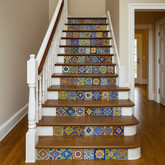
Tiled stair risers allow designers to create a sequence rather than a single surface. Repeating one motif produces formality, while alternating several patterns gives the staircase a collected and energetic quality.
Because the composition unfolds vertically, pattern order should be established before installation. A photographed dry layout can help the installer preserve the intended sequence and distribute colors evenly.
Bars, Islands, and Hospitality Features
In restaurants, hotels, and residential entertaining spaces, tile can help define a bar front, reception desk, kitchen island, or serving area. These vertical surfaces are highly visible but do not interfere with the functional work surface.
For hospitality projects, Talavera tile can reinforce a brand narrative and create a recognizable setting for guests. The material photographs well, but its true value lies in the depth and variation experienced in person.
Natural Materials Make Talavera Tile More Convincing
Designers often place handmade tile beside materials that share a sense of authenticity. Wood grain, stone variation, woven fibers, ironwork, leather, and plaster all have surfaces that develop character rather than remaining perfectly uniform.
These materials prevent colorful tile from feeling artificially applied. A Talavera backsplash beside wood cabinets appears connected to a broader handcrafted palette. A tiled fountain surrounded by stone and textured plaster feels integrated into the architecture.
Material contrast is equally useful. Glossy glazed tile can enliven matte plaster. Detailed patterns can balance broad wood grain. Saturated color can stand out against limestone, concrete, or soft neutral paint.
The designer’s task is to create relationships without making every material equally dominant. If the Talavera tile is intended to lead, nearby stone and wood should support it through color and texture rather than compete through excessive pattern.
Lighting Reveals the Craftsmanship
Glazed tile responds strongly to changes in light. Daylight reveals pigment variation and brushwork, while evening illumination can deepen the colors and create highlights across the surface.
Designers evaluate tile samples in the actual room because color viewed on a screen cannot account for orientation, daylight, wall color, or artificial lighting temperature. A cobalt pattern may feel crisp in cool light and richer under warmer fixtures.
Directional lighting can emphasize glaze and surface variation, but excessive glare may make a detailed motif difficult to read. Wall-washing fixtures, pendants, sconces, and under-cabinet lighting should be considered as part of the tile composition.
Samples should be placed vertically when evaluating a backsplash or wall installation. Tile viewed flat on a worktable receives light differently and may not accurately represent the finished result.
Specification and Installation Require Careful Planning
Handmade tiles may vary slightly in size, thickness, edge shape, glaze coverage, and color. These characteristics are part of their appeal, but they affect layout and installation.
Designers should confirm actual dimensions rather than relying only on nominal measurements. They should also determine whether the pattern has a fixed orientation, whether borders require specific corner pieces, and how the layout will meet cabinetry, floors, ceilings, or adjacent materials.
A suitable overage should be included for cuts, selection, accidental damage, and future repairs. The required amount depends on the project. Straightforward rectangular fields usually require less extra material than diagonal layouts, mixed patterns, niches, or installations with several borders.
Ordering the full quantity at one time helps maintain color continuity. Later production batches may contain glaze and pigment differences. Those differences can be attractive when distributed across a planned installation but difficult to incorporate into a completed wall.
Grout color should be tested with the physical tile. A grout close to the background color softens the grid and emphasizes the painted motif. Contrasting grout makes every tile edge more visible and can add unnecessary complexity to an intricate design.
An installer experienced with handmade tile can accommodate dimensional variation while preserving the visual order of the composition. This expertise is particularly valuable at corners, borders, outlets, niches, and transitions.
Craftsmanship Adds Emotional and Long-Term Value
Interior design is functional, but it is also emotional. People remember how a room feels, which details invite closer attention, and whether the materials seem authentic to the space. Handmade Talavera tile contributes to this experience because its production remains visible in the finished surface.
The process may involve preparing the clay, forming each tile, controlling the drying period, completing an initial firing, applying glaze, painting the decoration, and firing the tile again. Every stage affects the final color, texture, and durability.
Experienced artisans understand how pigments react to heat, how glaze behaves around painted lines, and how much variation a repeated motif can accommodate. This accumulated knowledge cannot be reduced to the appearance of a pattern alone.
For designers, craftsmanship provides a meaningful point of differentiation. Clients receive more than a fashionable color scheme; they receive an architectural detail connected to material knowledge and human skill. This can give the project relevance long after temporary trends have changed.
A Practical Checklist for Designers and Homeowners
Before selecting Talavera tiles, identify the role they will play in the room. Determine whether the installation is the primary focal point, a supporting accent, or a transition between materials.
Review physical samples beside cabinetry, counters, flooring, paint, metal finishes, and textiles. Observe the complete palette under natural and artificial light. If several patterns will be combined, create a dry layout that shows their actual distribution.
Confirm that the selected tile is appropriate for the intended location. A decorative wall tile may not meet the performance needs of a floor, exterior wall, shower floor, pool, or fountain. Ask about water exposure, maintenance, climate, glaze characteristics, and sealing requirements.
Plan trim, borders, corners, grout, and setting materials at the same time as the field tile. These details affect both appearance and performance. Finally, document the approved layout clearly so the installer understands pattern direction and focal alignments.
Explore Handmade Talavera Tiles for a Distinctive Project
The right tile selection begins with the architecture and the desired experience of the room. Pattern, palette, scale, lighting, and surrounding materials should work together to create a composition that belongs specifically to the project.
Explore handmade Mexican tiles, decorative patterns, borders, murals, and coordinating designs at Mexican Tile Store. Reviewing different collections can help identify options for kitchens, bathrooms, fireplaces, stair risers, courtyards, hospitality spaces, and other architectural applications.
For help with product selection, quantities, coordinating pieces, or application requirements, contact Mexican Tile Store before ordering. Early guidance can make it easier to resolve design and installation details while there is still flexibility in the project.
Conclusion
Interior designers use handmade Talavera tiles because they offer qualities that standardized surfaces cannot easily reproduce. They bring together color, pattern, glaze, material variation, and the visible contribution of the artisan.
These tiles can establish a focal point, connect a room’s palette, reinforce an architectural story, or introduce warmth into a contemporary interior. Through borders, mixed patterns, custom layouts, and carefully selected placements, designers can create installations tailored to the dimensions and character of a specific space.
The most successful projects treat Talavera tile as part of the architecture rather than an isolated decoration. Surrounding materials, lighting, grout, and installation details are chosen to reveal the craftsmanship and support the design’s visual hierarchy.
A one-of-a-kind interior does not need every component to be custom made. It needs materials with character and a composition that could only belong in that particular room. Handmade Talavera tile provides both: an established artistic tradition and enough variation, flexibility, and expressive potential to create something genuinely individual.