


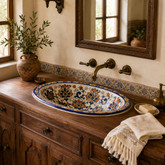
Why Oval Talavera Sinks Work So Well in Warm, Traditional Vanity Designs
A traditional bathroom vanity feels most inviting when its materials, proportions, and decorative details work together rather than competing for attention. Oval Talavera sinks are particularly well suited to this approach. Their softly curved shape introduces an elegant counterpoint to rectangular countertops and cabinetry, while their hand-painted surfaces bring color, craftsmanship, and Mexican ceramic tradition into an everyday fixture. The result can feel refined without becoming formal and decorative without losing practical purpose.
Unlike a plain white basin designed primarily to disappear into the countertop, a handmade Talavera sink can become an integral part of the vanity composition. Floral motifs, geometric patterns, cobalt blues, warm yellows, greens, and earthy accents provide opportunities to coordinate the sink with wood, stone, iron, brass, and surrounding tile. The oval form helps control that visual richness by giving the artwork a balanced, familiar silhouette.
For Spanish Colonial, Hacienda, Mediterranean, rustic, and other traditional interiors, oval Talavera sinks offer a compelling combination of proportion, warmth, artisan character, and functional beauty.
Why the Oval Shape Feels Naturally Traditional
Oval forms have long been used in traditional interiors because curves visually soften architecture. Bathroom vanities are usually dominated by straight lines: rectangular cabinets, horizontal countertops, square mirrors, doors, drawers, and wall surfaces. Introducing an oval sink interrupts those lines without creating a shape that feels disconnected from the room.
The transition is subtle. Rather than becoming aggressively geometric, the basin provides a graceful curve that can make the vanity feel more comfortable and visually balanced.
This characteristic is particularly useful in traditional design, where proportion and harmony are generally more important than dramatic contrast. An oval Talavera sink adds decorative interest while preserving a sense of familiarity.
Hand-Painted Talavera Adds Warmth to the Vanity
The shape of the sink provides balance, but the Talavera decoration supplies much of its warmth. Authentic artisan ceramics naturally display subtle differences in brushwork, pigment, glaze, and pattern. Those details prevent the vanity from feeling mechanically uniform.
Warmth in interior design does not necessarily mean using only warm colors. Cobalt blue, for example, can still contribute to an inviting room when combined with handmade brushwork, natural wood, textured plaster, and warm metal finishes.
The important distinction is that Talavera has visual depth. Its colors are part of a handcrafted glazed surface rather than a flat printed decoration, giving the vanity an artisanal quality that works especially well with traditional materials.
A Natural Match for Wood Vanities
Wood and Talavera are an especially effective combination. Wood provides grain, warmth, and architectural substance, while the ceramic sink introduces color and detailed artwork.
A dark stained vanity can create dramatic contrast with a bright Talavera basin. Medium and lighter woods produce a softer composition that emphasizes the handcrafted character of both materials. Reclaimed or intentionally rustic cabinetry can push the design toward Hacienda or farmhouse influences.
The oval sink also allows a substantial amount of countertop and vanity material to remain visible around the basin. This creates a layered composition in which the cabinetry, countertop, and ceramic can each contribute to the finished design.
Pairing Oval Talavera Sinks with Stone Countertops
Natural stone can provide a quiet visual foundation for an expressive Talavera pattern. Limestone, travertine, marble, and other appropriate countertop materials offer organic movement without necessarily competing with the painted ceramic.
For a highly patterned sink, a relatively restrained stone often allows the artwork to remain the primary focal point. A simpler Talavera design can accommodate more movement in the countertop.
The objective is not to make every surface decorative. Traditional vanity design often works best when one element provides the strongest visual statement while the surrounding materials support it.
Why Oval Sinks Work Well with Decorative Patterns
An oval basin creates a natural frame for hand-painted decoration. Floral and botanical motifs can follow the curvature of the bowl, while geometric patterns can create concentric visual movement toward the drain.
The absence of sharp interior corners also allows many decorative compositions to flow continuously around the basin. This can make the painted design feel integrated with the form of the sink rather than simply applied to a flat surface.
From above, the oval silhouette helps contain intricate artwork within a clearly defined shape. This is particularly valuable when the surrounding countertop and vanity are relatively simple.
Creating a Spanish Colonial Vanity
Spanish Colonial bathrooms frequently combine plaster, dark wood, iron, ceramic, stone, and warm architectural finishes. An oval Talavera sink fits naturally within this material vocabulary.
A substantial wood vanity can establish the foundation, while the hand-painted basin provides the primary ceramic accent. A wrought iron mirror or lighting fixture can reinforce the traditional character without requiring every element to feature decorative ornament.
Talavera tiles can also be incorporated selectively into the backsplash. Coordinating rather than perfectly matching the sink and tile usually creates a more layered appearance.
Talavera Sinks in Hacienda-Style Bathrooms
Hacienda-inspired bathrooms often emphasize natural texture and craftsmanship. Wood cabinetry, plaster walls, terracotta, iron, stone, and colorful ceramics can all contribute to the design.
Within this environment, an oval Talavera sink feels less like an added decorative object and more like part of the architectural language. Its handmade character connects naturally with materials that show grain, texture, aging, and artisan production.
For a more traditional effect, the sink can feature a richly colored Mexican pattern. For a quieter interpretation, a limited palette can preserve the Talavera character while allowing the vanity and surrounding architecture to remain dominant.
Using Talavera in Mediterranean-Inspired Vanities
Mediterranean interiors share many materials with Mexican and Spanish-influenced design, making Talavera sinks surprisingly versatile in these spaces. Textured walls, natural stone, warm woods, arches, and aged metals provide an appropriate setting for hand-painted ceramics.
Blue-and-white Talavera can create a particularly effective Mediterranean connection, while multicolored patterns introduce a stronger Mexican influence.
The oval shape helps bridge these traditions because it is visually familiar and understated. The artwork provides cultural personality while the form remains adaptable.
Choosing the Sink as the Vanity's Focal Point
A successful traditional vanity does not require every component to compete for attention. If the Talavera sink contains an intricate pattern and several strong colors, it can serve as the primary decorative focal point.
Cabinetry can then provide warmth through wood grain, while the countertop remains comparatively restrained. Hardware, faucets, and mirrors can repeat selected tones or materials without reproducing the sink's pattern.
This hierarchy makes the room easier to read visually. The eye first notices the hand-painted basin and then discovers the supporting details around it.
Coordinating the Faucet with a Talavera Sink
Faucet selection can substantially influence the finished character of a Talavera vanity. Warm metal finishes frequently complement traditional ceramic patterns because they reinforce the handcrafted atmosphere of the room.
Aged brass, bronze-inspired finishes, and other traditional metal treatments can pair naturally with colorful Talavera. The exact choice should respond to the sink pattern, cabinetry, mirror, and hardware rather than being selected independently.
Faucet scale is equally important. A decorative sink already carries considerable visual information, so an excessively ornate faucet can make the vanity feel crowded. A well-proportioned fixture often provides the stronger result.
Using Talavera Tiles Behind the Sink
A Talavera sink does not require a matching Talavera backsplash, but combining the two can create a cohesive traditional bathroom when handled carefully.
One approach is to choose backsplash tiles that repeat one or two colors from the sink without duplicating its exact pattern. Another is to use simpler field tiles around a more decorative basin.
If both the sink and backsplash feature intricate patterns, introducing a visual boundary—such as a simple countertop or neutral wall area—can prevent the composition from becoming overly dense.
The objective should be coordination rather than exact duplication.
Why Handmade Variation Belongs in Traditional Design
Traditional interiors often benefit from materials that reveal how they were made. Natural stone varies from slab to slab, wood contains unique grain, forged iron shows subtle evidence of fabrication, and handmade Talavera exhibits differences in painting and glazing.
Individual Talavera sinks may therefore present slight variations in color intensity, brushstroke, pattern placement, glaze, dimensions, or other handmade characteristics. These differences are part of artisan production rather than the precision associated with industrial manufacturing.
For a traditional vanity, these variations can actually strengthen the design. They prevent the sink from feeling mass-produced and reinforce its relationship with other natural and handcrafted materials.
The Craftsmanship Behind a Handmade Talavera Sink
The visual character of Talavera begins long before the sink reaches the bathroom. Clay must first be prepared and formed into the basin. The piece is allowed to dry before undergoing an initial firing that creates the ceramic body.
Decoration is then applied by hand. Artisans use brushes to create the patterns and colored details that distinguish one design from another. Because the work is manual, the movement and pressure of the brush naturally produce subtle individuality.
Glazing and subsequent kiln firing transform the painted ceramic into the recognizable finished surface. Heat affects pigments and glaze, contributing to the depth of color and slight variations found from piece to piece.
This multi-stage process explains why an artisan Talavera sink has a different visual presence from a mechanically decorated basin.
Practical Advantages of an Oval Basin
The appeal of an oval Talavera sink is not exclusively decorative. The familiar shape is practical for residential vanity layouts and can work with many countertop configurations.
Its rounded geometry eliminates pronounced corners within the bowl and creates a comfortable visual relationship with rectangular vanity tops. Depending on the specific sink model and installation method, the oval format can also leave useful countertop space around the basin.
As with any bathroom fixture, homeowners should verify the actual sink dimensions, countertop opening, faucet placement, plumbing requirements, and installation method before cabinetry or stone is permanently fabricated.
Planning the Vanity Around a Handmade Sink
Because handmade ceramic pieces can exhibit dimensional variation, it is prudent to have the actual sink available before making the final countertop cutout whenever the installation method requires one.
This allows the fabricator or installer to work from the physical basin rather than relying exclusively on nominal dimensions. The same planning helps determine faucet position and available clearance around the sink.
These practical decisions are particularly important with custom vanities, natural stone countertops, and other materials where correcting an incorrectly sized opening may be difficult.
Using an Oval Talavera Sink in a Powder Room
Powder rooms are excellent locations for decorative sinks because their smaller dimensions allow a single distinctive fixture to establish the personality of the entire room.
An oval Talavera sink can provide the primary color and pattern while the remaining design stays relatively restrained. A wood vanity, warm metal faucet, mirror, and simple wall finish may be all that is necessary to create a complete composition.
This approach gives guests a memorable visual experience without requiring extensive decorative treatment across every wall.
Creating a Refined Guest Bathroom
Guest bathrooms can benefit from Talavera for similar reasons. A handmade sink communicates attention to detail and gives the room a more considered appearance than a purely utilitarian fixture.
For a quieter guest bath, designers can choose a Talavera pattern with a controlled palette and repeat one of its colors elsewhere in the room. Towels, tiles, cabinetry, or small accessories can provide subtle connections without attempting to match the ceramic exactly.
The result feels coordinated while preserving the sink's individuality.
Balancing Pattern in a Small Bathroom
A small room does not necessarily require a plain sink. In fact, limited square footage can make an artistic fixture more effective because fewer competing elements are needed.
The key is balance. If the Talavera sink is highly colorful, surrounding walls and countertops can remain relatively quiet. If the room already includes patterned tile, a sink with a more limited palette may provide sufficient character without excessive visual competition.
Scale should also be considered. The sink, vanity, mirror, and lighting should feel proportionate to one another so the decorative ceramic enhances the room rather than overwhelming it.
Why Talavera Can Feel Luxurious Without Feeling Formal
Luxury is increasingly associated with authenticity and craftsmanship rather than perfect uniformity. Handmade Talavera fits this perspective because its value comes from skilled labor, artistic detail, and individual character.
An oval Talavera sink can make a traditional vanity feel special without creating the polished formality associated with more conventional luxury bathrooms. Its colors and brushwork add warmth, while its familiar curved shape keeps the composition approachable.
This balance is especially effective in homes where the goal is refined comfort rather than showroom perfection.
Creating a Vanity That Ages Gracefully
Traditional bathrooms are often designed with longevity in mind. Natural wood, stone, iron, brass, and handcrafted ceramic have aesthetic qualities that are not dependent on a single seasonal trend.
Talavera belongs naturally within this group. Its appeal comes from an established ceramic tradition and the individuality of hand-painted decoration rather than from temporary styling.
Choosing a sink whose palette works with the permanent architectural materials of the bathroom can help the vanity remain visually relevant even as paint colors, textiles, and accessories change over time.
Explore Handmade Mexican Talavera Bathroom Sinks
For homeowners and designers creating a traditional vanity, the sink provides an opportunity to introduce authentic craftsmanship at the center of the composition. You can explore handmade Mexican Talavera bathroom sinks to discover colorful ceramic designs for bathrooms, powder rooms, and custom vanity projects.
You can also explore Mexican Tile Store for Talavera tiles and other Mexican ceramic products that can help coordinate the surrounding interior.
If you have questions about a sink, dimensions, design selection, or coordinating Talavera with your project, you can contact our team for additional assistance before planning the final installation.
Conclusion: A Natural Centerpiece for a Warm Traditional Vanity
Oval Talavera sinks work exceptionally well in warm, traditional vanity designs because they combine a gentle, familiar shape with the individuality of handmade Mexican ceramics. The oval silhouette softens the straight geometry of cabinetry and countertops, while hand-painted patterns introduce color, movement, and artisan character.
They can complement wood, stone, plaster, brass, iron, and decorative tile across Spanish Colonial, Hacienda, Mediterranean, rustic, and other traditional interiors. Just as importantly, the natural variations created through hand painting, glazing, and firing ensure that each basin contributes its own character to the room.
A thoughtfully designed vanity does not need excessive ornament to feel distinctive. By making an authentic oval Talavera sink the focal point and allowing surrounding materials to support it, homeowners can create a bathroom that feels warm, personal, and connected to a lasting tradition of Mexican craftsmanship.