


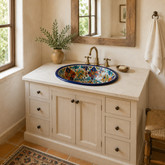
How Decorative Oval Talavera Sinks Turn a Simple Vanity into a Focal Point
A simple bathroom vanity can become the defining feature of the room when one element carries enough visual character to anchor the entire composition. Decorative oval Talavera sinks are especially effective because they combine a familiar, balanced shape with hand-painted color, artisan variation, and a strong connection to Mexican ceramic tradition. Rather than disappearing into the countertop, the sink becomes part of the room’s architecture and visual identity.
This transformation does not require an elaborate vanity or excessive decoration. In fact, Talavera often works best when surrounding materials are relatively restrained. A wood cabinet, a simple stone top, a warm metal faucet, and a carefully selected oval sink can create a more memorable bathroom than a heavily ornamented design with no clear focal point.
For powder rooms, guest bathrooms, Spanish Colonial interiors, rustic luxury spaces, and even contemporary vanities, decorative oval Talavera sinks offer an efficient way to introduce color, craftsmanship, and personality exactly where the eye naturally lands.
Why the Sink Is a Natural Focal Point
The vanity is one of the most visually important areas in a bathroom. It usually combines the sink, faucet, countertop, mirror, cabinetry, and lighting into a compact architectural composition. Because people approach this area directly, the sink naturally sits near the center of attention.
A conventional white basin often minimizes its presence, allowing other elements to carry the design. A hand-painted Talavera sink does the opposite. Its color and pattern make it visually active, which immediately changes the hierarchy of the vanity.
Instead of treating the sink as background plumbing, the design begins with the ceramic itself. The countertop, cabinet finish, mirror, and hardware can then be selected to support that focal point.
Why Oval Talavera Sinks Feel So Balanced
The oval shape plays an important role in the effectiveness of the design. Most vanities contain strong horizontal and vertical lines: rectangular cabinets, straight countertops, square mirrors, drawer fronts, and wall planes.
An oval basin interrupts that geometry with a softer curve. This makes the sink visually distinctive without making the vanity feel chaotic. The shape is decorative but familiar, so it can support elaborate hand-painted patterns without becoming too aggressive.
The combination of a structured vanity and a rounded sink often produces a well-balanced composition. The cabinetry provides order, while the ceramic introduces movement.
Color Creates Immediate Visual Impact
One of the fastest ways to turn a simple vanity into a focal point is through color. Talavera sinks offer a particularly effective form of color because the pigments are integrated into a handcrafted glazed surface rather than applied as a flat decorative finish.
Deep cobalt blue can create contrast against light countertops. Yellow and terracotta can add warmth to dark wood. Green and white can create a fresher palette. Multicolored patterns can bring considerable energy to an otherwise restrained bathroom.
Because the sink occupies a relatively compact area, it allows homeowners to introduce strong color without covering an entire wall or committing the whole bathroom to a bold palette.
Hand-Painted Pattern Adds More Than Decoration
Pattern gives Talavera sinks their distinctive personality. Floral motifs, geometric arrangements, traditional Mexican designs, and botanical forms can all influence how the vanity feels.
A dense multicolored pattern can make the sink the dominant artistic element. A simpler blue-and-white composition can provide a more refined focal point. Repeating motifs can introduce rhythm, while more organic painting creates a relaxed handcrafted quality.
The important distinction is that these designs are applied by hand. Brushstroke variation gives the surface depth and individuality that printed patterns cannot fully reproduce.
Simple Vanities Often Showcase Talavera Best
A focal point requires visual space around it. This is why a decorative Talavera sink can be more effective on a simple vanity than on one already covered in elaborate detailing.
Plain wood cabinetry, a relatively calm countertop, and straightforward hardware allow the ceramic artwork to become the primary feature. The sink does not need to compete with heavily carved doors, dramatic stone movement, or several unrelated patterns.
This principle is useful in both traditional and contemporary bathrooms. Simplicity in the surrounding materials can make the handmade sink feel more valuable and intentional.
Pairing Talavera with Natural Wood
Wood is one of the strongest companion materials for a decorative oval Talavera sink. Its grain provides warmth without competing with the painted ceramic.
Dark stained cabinetry can create a dramatic backdrop for colorful sinks, especially those featuring white, yellow, or cobalt. Medium woods create a softer and more relaxed traditional atmosphere. Rustic or reclaimed wood can reinforce Hacienda, farmhouse, and old-world influences.
The natural variation of wood also relates well to the handmade variation of Talavera. Both materials avoid the sterile uniformity of industrial surfaces, helping the vanity feel more authentic.
Using Stone as a Quiet Background
Natural stone countertops can add refinement while allowing the Talavera sink to remain visually dominant. The best relationship often comes from balance rather than competition.
If the sink contains a highly complex multicolored design, a calmer stone can provide visual breathing room. If the Talavera pattern is restrained, a countertop with somewhat more movement may still work successfully.
The sink and stone do not need to match. Instead, one or two tones within the Talavera design can connect subtly with the countertop, creating cohesion without making the composition feel overly coordinated.
Warm Metal Fixtures Reinforce the Focal Point
Faucets and hardware contribute more to the final vanity design than their relatively small size might suggest. Warm metal finishes often complement Talavera particularly well because they reinforce the handmade, traditional atmosphere.
Aged brass, bronze-inspired finishes, and similar warm metals can relate naturally to yellow, terracotta, blue, and green ceramic palettes. Wrought iron mirrors or lighting can strengthen Spanish Colonial and Hacienda influences.
The faucet itself does not need excessive ornament. When the sink is already decorative, a well-proportioned fixture with a complementary finish can be more effective than a highly elaborate one.
Why Talavera Works So Well in Powder Rooms
Powder rooms are ideal spaces for strong focal points. Because they are usually compact and used for shorter periods, designers can introduce more personality without needing to decorate a large environment.
An oval Talavera sink can establish nearly the entire visual identity of a powder room. A simple vanity, mirror, faucet, and wall finish may be enough to complete the composition.
This makes Talavera particularly efficient from a design perspective. A relatively small artisan element can create a memorable room without requiring extensive decorative work.
Creating a Focal Point in a Guest Bathroom
Guest bathrooms benefit from decorative sinks for similar reasons. A hand-painted basin communicates attention to detail and gives visitors something distinctive to notice.
The sink can also provide the color direction for the rest of the room. Towels, small accessories, wall colors, and even lighting details can repeat one or two tones from the ceramic without reproducing its entire pattern.
This creates a coordinated interior while allowing the Talavera sink to remain the primary artistic feature.
Spanish Colonial Vanities and Talavera
In Spanish Colonial bathrooms, the sink can become part of a larger architectural language. Dark wood, plaster, iron, terracotta, stone, and handmade ceramic all work naturally together.
An oval Talavera sink reinforces this material vocabulary without feeling added as an afterthought. Its curves soften heavier cabinetry, while its colors break up expanses of wood and stone.
The result is a vanity that feels traditional, warm, and connected to craftsmanship rather than simply decorated in a historical style.
Hacienda-Style Bathrooms
Hacienda interiors often prioritize warmth, natural texture, and artisan character. Decorative Talavera sinks fit naturally into this approach because they contribute both color and cultural identity.
A substantial wood vanity paired with a hand-painted oval basin can create a strong central feature. Add warm metal fixtures, a simple plaster wall, and perhaps a restrained Talavera backsplash, and the vanity immediately feels architectural rather than generic.
The key is allowing each material to retain its own character instead of forcing every element to match exactly.
Contemporary Bathrooms Can Use Talavera Too
Decorative Talavera sinks are not limited to traditional spaces. In contemporary bathrooms, they can provide precisely the contrast needed to keep a neutral interior from feeling impersonal.
A streamlined vanity with flat-front cabinetry and a simple stone top creates a clean background. Against that backdrop, a colorful oval Talavera sink reads almost like a piece of ceramic sculpture.
This contrast between modern geometry and handmade decoration can make the sink appear even more distinctive.
Using the Sink to Guide the Color Palette
One practical advantage of choosing the Talavera sink early in the design process is that it can serve as the palette reference for the entire vanity.
A cobalt detail might inspire the wall color. A terracotta accent could connect with flooring. Green could appear subtly in textiles or accessories. Yellow may coordinate with warm metals or lighting.
Using colors already present in the sink helps the rest of the room feel connected without requiring exact matches.
Do Not Over-Match the Bathroom
One of the easiest ways to reduce the impact of a focal point is to repeat it too literally everywhere else. If the sink, backsplash, walls, accessories, and textiles all use the same pattern, the eye has nowhere to settle.
Talavera usually benefits from controlled contrast. The sink can carry the most detailed pattern while nearby materials repeat only selected colors or simpler motifs.
This approach keeps the ceramic distinctive and makes the overall vanity feel more sophisticated.
Pairing an Oval Sink with Talavera Backsplash Tiles
A Talavera backsplash can complement a decorative sink when the relationship is thoughtfully planned. The tiles do not need to duplicate the sink pattern.
A simpler tile design can support a highly decorative basin. Alternatively, full-pattern tiles can frame a sink with a quieter palette. Solid or predominantly single-color Talavera pieces can also provide a visual bridge between the sink and surrounding materials.
The most successful combinations usually share color relationships rather than identical artwork.
The Mirror Helps Frame the Composition
Because the mirror sits directly above the sink, it plays an important role in reinforcing the focal point. Its shape, frame, and scale should support the vanity rather than distract from it.
A wrought iron mirror can strengthen traditional Mexican or Spanish influences. A simple wood frame can echo the cabinetry. A relatively minimal mirror can make a highly decorative Talavera sink appear even more prominent.
Oval and arched mirrors can also repeat the curves of the basin, while rectangular mirrors provide a stronger contrast.
Lighting Makes the Ceramic More Expressive
The glossy glaze of Talavera interacts with light, making bathroom lighting an important part of the finished appearance. Properly positioned sconces or overhead lighting can help reveal differences in color and surface character.
Very harsh lighting may flatten the atmosphere, while warmer illumination can enhance wood tones, brass, and traditional ceramic colors.
Natural daylight can also make the sink look subtly different throughout the day as reflections move across the glaze.
Why Handmade Variation Strengthens the Focal Point
Part of what makes a decorative Talavera sink visually engaging is that it does not look mechanically perfect. Handmade production naturally creates slight variations in brushwork, color intensity, glaze, pattern placement, and dimensions.
These differences are not defects. They are part of the uniqueness of artisan ceramics and help the sink feel like an individual object rather than one of thousands of identical fixtures.
In a simple vanity, these small variations become especially noticeable because the eye has room to appreciate the ceramic itself.
The Craftsmanship Behind the Visual Impact
The focal quality of a Talavera sink is directly connected to how it is made. Clay must be prepared and formed into the basin before drying and undergoing an initial firing.
Artisans then apply decorative patterns by hand using brushes and mineral-based pigments. The ceramic is glazed and fired again, allowing the final colors and glossy surface to develop.
This process means the sink carries evidence of multiple stages of human work. Its visual impact is not created through digital printing alone but through shaping, painting, glazing, and firing.
Oval Sinks Create a Strong Visual Center
The geometry of an oval naturally directs the eye inward. Unlike a rectangle, which emphasizes corners and edges, an oval creates continuous visual movement around the basin.
This can be particularly effective with decorative patterns that radiate toward the drain or wrap around the bowl. The artwork feels contained within a graceful boundary, giving even elaborate designs a sense of order.
This is one reason oval Talavera sinks can be bold without making the vanity feel visually uncontrolled.
Designing Around the Sink Before Fabricating the Countertop
Because Talavera sinks are handmade, planning should account for natural dimensional variation. For installations that require a countertop cutout, working with the actual sink before final fabrication is a prudent approach.
This allows the fabricator or installer to confirm the basin profile, opening, faucet placement, and surrounding clearances based on the physical piece rather than depending entirely on nominal dimensions.
This practical step helps protect the design investment and ensures the focal point is integrated correctly into the vanity.
Small Bathrooms Benefit from One Strong Feature
A small bathroom does not need several dramatic elements to feel designed. One strong focal point can be more effective than many competing details.
An oval Talavera sink offers exactly this opportunity. Its color and pattern provide personality, while the rest of the room can remain comparatively quiet.
This strategy also keeps the space visually organized. Rather than shrinking the room with too many patterns, the design directs attention to one carefully chosen artisan feature.
Luxury Through Individuality
Luxury bathroom design increasingly values custom character and authentic craftsmanship. A Talavera sink contributes to this type of luxury because its appeal is based on individual artistry rather than standardization.
Even a modest vanity can feel more considered when its central fixture has been made and painted by hand. The value comes from the quality of the design decision and the craftsmanship of the piece, not simply from adding expensive materials everywhere.
This makes Talavera an effective option for homeowners who want a bathroom to feel distinctive without becoming excessively formal.
Explore Decorative Oval Talavera Sinks
If you are planning a vanity and want the sink to become a meaningful part of the interior rather than simply a functional necessity, you can explore handmade Mexican Talavera bathroom sinks for colorful oval designs and other artisan ceramic options.
You can also explore Mexican Tile Store for coordinating Talavera tiles and decorative ceramics that can help complete a bathroom design.
For questions about sink selection, dimensions, colors, or planning a vanity around a particular piece, you can contact our team for additional assistance.
Conclusion: One Handmade Sink Can Redefine the Entire Vanity
A decorative oval Talavera sink can turn a simple vanity into a focal point because it combines color, pattern, shape, and craftsmanship in one highly visible element. The oval silhouette softens the straight geometry of cabinetry and countertops, while hand-painted decoration introduces character that standard fixtures rarely provide.
The transformation does not depend on creating a complicated bathroom. In many cases, simple surrounding materials make the Talavera sink even more effective. Wood, stone, warm metals, restrained tile, and thoughtful lighting can support the ceramic while allowing it to remain the visual center.
For homeowners and designers who want a bathroom vanity to feel personal, artistic, and connected to authentic Mexican craftsmanship, a decorative oval Talavera sink offers a powerful solution: one functional fixture capable of changing the identity of the entire space.